A frail figure lay collapsed along the edge of a bustling roadway, nearly invisible to the world rushing past her. She was a Great Dane, once a majestic and noble breed, now reduced to a ghost of herself—bones jutting out from beneath sagging skin, eyes dulled by pain and hunger, body too weak to rise, too exhausted to drink even a sip of water. Her name, as we would come to learn, was Odji.
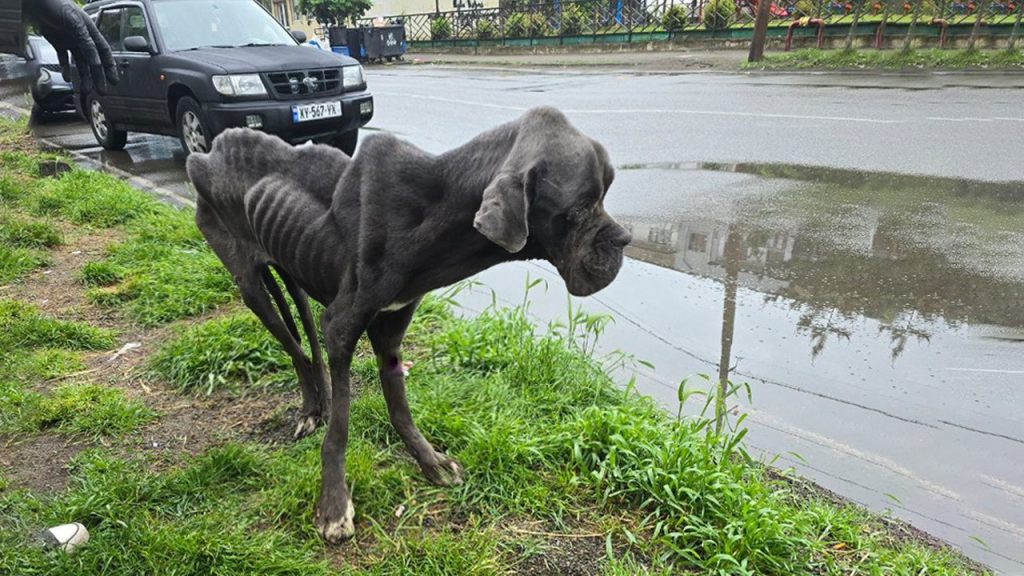
Cars zipped by, people walked past—some merely glanced, others waved her off, as though she were nothing more than a nuisance. Not one person stopped to ask, “Are you okay?” Not one hand reached out—until one finally did. A kind-hearted rescuer, moved by compassion and unable to ignore the suffering before him, knelt beside her and offered something no one else had: hope.
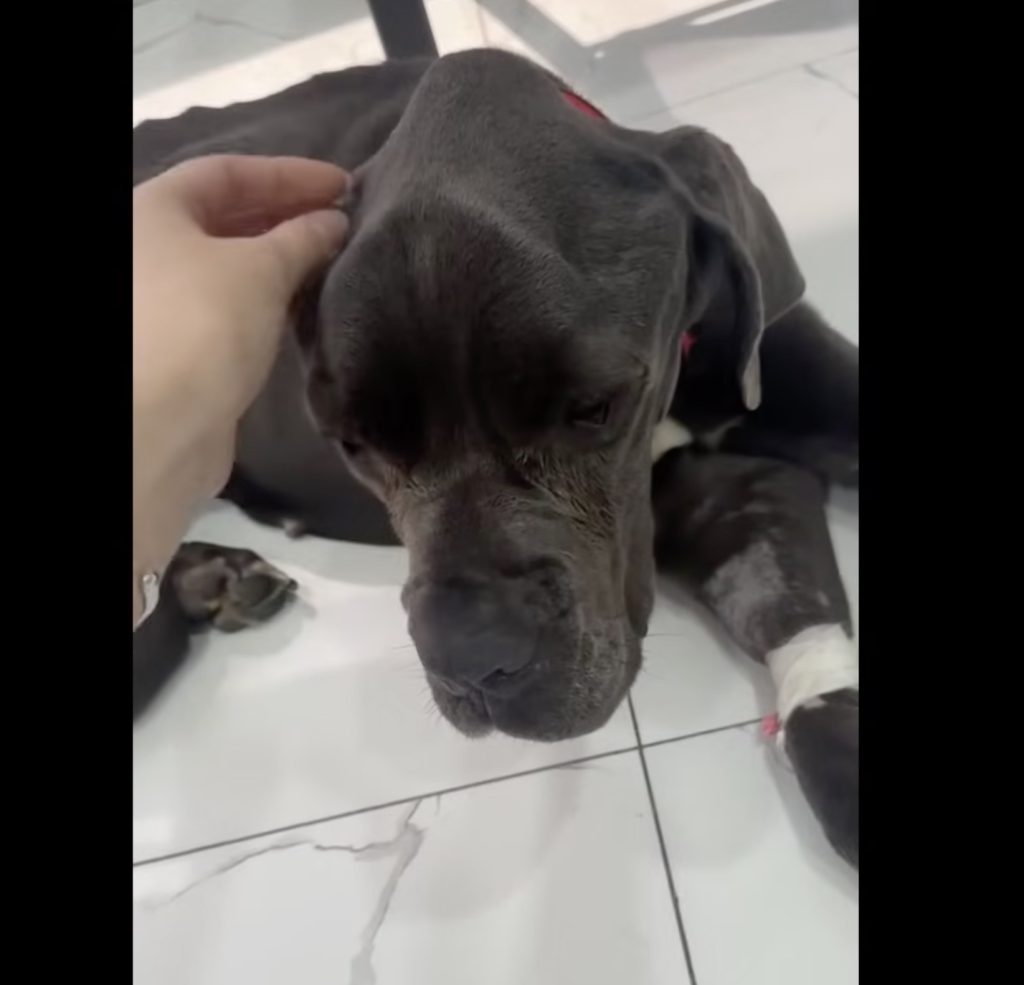
Odji was rushed to a veterinary clinic, her body limp in the arms of her rescuer. The vet’s face grew serious as the examination revealed the truth—this poor girl was severely malnourished, her body wracked by starvation, neglect, and a severe tick infestation. Her muscles had all but wasted away, her organs were barely functioning, and her body temperature was dangerously low. She was given a mere 1% chance of survival. Then came the seizure.
Her body convulsed, and for a chilling moment, it seemed that her little spark might flicker out for good. The room grew silent. Everyone held their breath.
But Odji wasn’t ready to give up.
Something deep inside her fought back—some memory, perhaps, of what it felt like to run freely, to be loved, to matter. Against the odds, she made it through that night.
The days that followed were filled with constant care. IV fluids were administered around the clock to hydrate her fragile frame. Gentle hands stroked her head, whispering encouragement. Her body remained still for hours, then days, but slowly—miraculously—change began.
Her eyes, once dim, started to focus. Her ears perked slightly at voices she was beginning to recognize. And then, one trembling step at a time, Odji began to move.
There was nothing graceful about those early attempts. Her legs buckled under her weight, and more than once, she collapsed again. But each time, she got back up. Her body, fed carefully with soft, nutritious meals, began to rebuild itself. Her ribs softened beneath growing muscle. Her dull, lifeless coat took on a new sheen. A spark began to light in her eyes again—not just survival, but spirit.
In one especially tender moment, the rescuer called her name. “Odji.” She lifted her head. For the first time, she responded. That simple act—recognizing her name—was a sign of life that brought tears to many who had watched her journey.
She started learning things that, in a different life, might’ve been second nature. “Sit.” “Paw.” Commands that brought tail wags and proud grins when she got them right. Toys were introduced. At first, she didn’t understand what to do with them—she had likely never played a day in her life. But instinct kicked in. The first time she chased a ball and brought it back, her joy was unmistakable. Her tail wagged furiously, her ears bounced with each step, and laughter filled the air.

Then came the beach.
Wide open space. Soft sand beneath her paws. Gentle waves lapping nearby. Odji ran—not just walked, not stumbled—ran. She chased balls, leapt into the air, and rolled in the sand like a puppy seeing the ocean for the first time. Her freedom was complete.
The final moments of her journey show a dog reborn. Her body, once skeletal and frail, is now strong and healthy. Her coat shines under the sun, her eyes are bright and filled with curiosity. She lives now in a forever home, surrounded by love, comfort, and safety—things she had never known before.
But perhaps the most beautiful part of Odji’s story isn’t just the physical transformation. It’s the way she teaches us about resilience. About how life, even when it seems all but lost, can bloom again with just a little compassion, care, and time. She reminds us that every soul, no matter how broken, is worthy of being saved.
Many who followed Odji’s journey say they were changed by it. They watched a creature so close to death come back to life, not because of some miracle cure, but because someone chose to care. Someone chose to stop. To reach out. To believe that life—no matter how broken—still has value.
For those of us who are older, who have seen the world change in so many ways, Odji’s story touches something deeper. It reminds us of a time when people looked out for one another, when kindness wasn’t rare, when a helping hand was always within reach. Her story rekindles that old truth: we all need each other, especially the most vulnerable among us.
Odji is more than a rescue dog. She’s a symbol of what love can do. Of what happens when we don’t turn away. Of how healing doesn’t always come in grand gestures, but in the small, consistent acts of care.
In a world that too often rushes by suffering, Odji’s journey calls us to slow down, to notice, and to act. She is a living, breathing reminder that every life matters—and that hope, no matter how faint, can still shine bright.
Let her story be a candle in the dark. A quiet testament to the power of compassion. And a gentle nudge to all of us: the next time we see someone—or something—in need, don’t walk away.
Stop. Reach out. And believe in the possibility of transformation.
Because sometimes, the smallest act of kindness can spark the greatest miracle.