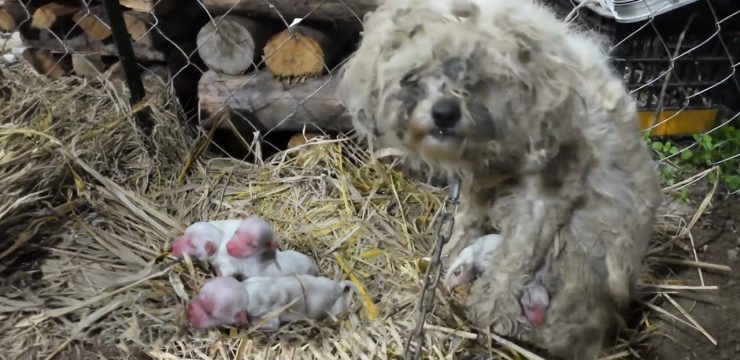
For sixteen long years, Youngji—a senior dog with kind eyes and a gentle soul—lived in quiet suffering. Chained outside through rain and shine, summer heat and bitter winters, she never knew the feeling of soft bedding or a caring touch. There was no cozy corner, no warm hug, no sense of home. Her entire world was a patch of dirt beneath her feet and the rusted length of chain that defined her existence.

When rescuers finally found her, what they saw was heartbreaking. Youngji’s body was frail, her belly so swollen she could barely stand. Each breath looked like a struggle. Her abdomen was severely distended from ascites—a condition where fluid accumulates in the abdomen, often due to heart or liver issues. Her legs trembled under the weight of that fluid, and even sitting seemed painful. Yet despite the pain, she looked up with eyes that were calm and kind. No bark. No growl. Just silent endurance.
Her former owner, when asked why she had been left in such a state, replied with chilling indifference: “She’s too old. She’s already lived her life.” As if the passing of years could excuse a lifetime of neglect. As if age meant she no longer deserved love, care, or dignity.
But the rescue team saw something else. They saw a dog who had waited her whole life for a chance. They saw hope flickering in her slow tail wags and the way she gently leaned her head into their hands—trusting complete strangers more than she’d ever trusted the humans she’d lived with for over a decade.
At the veterinary hospital, the news was sobering. Youngji was suffering from heartworm disease, heart complications, and serious lung damage. Her body had been fighting for years, silently and without help. The veterinarians had to drain more than 8 liters of fluid from her abdomen—more than some small dogs weigh entirely. It was an immense amount, but it offered her a bit of relief. She could breathe a little easier. Her tiny steps became slightly less burdened.
Still, the damage to her body couldn’t be undone overnight. The journey ahead would be long and uncertain. She struggled to walk even a few steps. Her muscles were weak from years of disuse, and every small movement took great effort. But now, for the first time in her life, she was surrounded by people who didn’t look away. People who believed that even in her twilight years, Youngji mattered.
They bathed her gently, wiped the dirt from her fur, and whispered soft words of comfort into her ears. They brought her warm food, soft blankets, and patient hands. They didn’t expect her to recover quickly. They simply wanted her to know she was safe. That she was loved. That her life—no matter how long or short—was worth something.
One of the most moving moments came when Youngji, after days of resting, stood on her own and slowly walked toward the volunteers. She didn’t make it far, but she didn’t need to. That small act was her way of saying, “I’m still here. I’m still trying.” The room was silent except for the soft hum of the machines—and the quiet sniffles of those who had come to love her.
Youngji’s story is not an easy one to hear. It is painful. It is unfair. But it is also a testament to the strength of the spirit, and the difference even a little kindness can make. This sweet dog, forgotten and ignored for most of her life, still had love to give. Still had a spark inside her that hadn’t been extinguished by all the years of neglect.
Now, she is living out her remaining days in comfort. She has a warm place to sleep. She is given medication, soft meals, and the chance to feel grass under her paws without a chain attached to her neck. Her caregivers sit with her, talk to her, and make sure she never feels alone again.
This story is more than just about one dog. It’s about the quiet suffering so many animals endure in silence. It’s about how easy it can be to overlook those who cannot speak for themselves. And it’s about how, with just a little compassion, everything can change.
Youngji will never get back those sixteen lost years. But thanks to the hearts of the people who rescued her, she now knows what love feels like. She now knows that she is not forgotten. That her life has meaning. That even in the last chapter, the story can shift toward something beautiful.
For anyone who has ever loved a senior pet—or who has wondered whether it’s too late to make a difference—Youngji’s journey is a powerful reminder. It’s never too late to care. Never too late to love. And never too late to give a soul the peace it has always deserved.
Her body may still be fragile. Her legs may still tremble. But her spirit? Her spirit is stronger than ever.
Let Youngji’s story remind us all: every life matters. And sometimes, the most broken souls are the ones most worth saving.