Curled up in the snow, soaked to the bone, and shaking uncontrollably, a tiny dog lay motionless—too exhausted to run, too scared to cry. His frail body trembled under the weight of bitter cold, and his bloodshot eyes, filled with pain and confusion, seemed to ask a haunting question: Why was I left here?
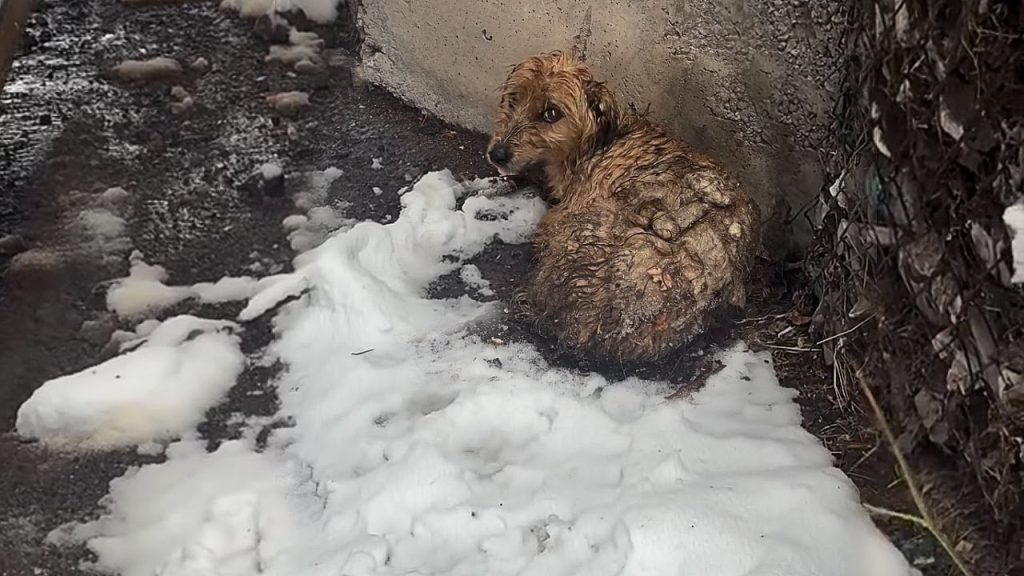
That’s how the rescue began. A compassionate soul stumbled upon him lying helplessly in a desolate patch of snow. He wasn’t barking, he wasn’t whining—just shivering in silence, as though he had already given up. At just over a year old, the little dog was already far too familiar with abandonment and suffering. His fur was drenched, his limbs stiff from the cold, and his breathing was labored. Yet despite the freezing winds and layers of ice around him, he made no attempt to flee. He couldn’t.
Closer inspection revealed the devastating truth—he was dangerously malnourished, his small frame reduced to little more than skin and bones. His ribs protruded through his wet coat, and he appeared to have sustained eye injuries that caused visible bleeding. But more heartbreaking than the physical pain was the emotional toll. His eyes, wide with fear, lacked the sparkle of hope, replaced instead by a vacant, distant stare that spoke of betrayal and sorrow.
The rescuer, deeply moved, didn’t rush in. He knew that building trust was the first step toward saving this broken soul. Kneeling gently beside him, he whispered words of comfort, assuring the little dog that he was no longer alone. The tone of his voice—calm, soft, unwavering—was the first warmth the dog had likely felt in days. Minutes turned into hours as he continued talking, patiently waiting for the fragile creature to believe that not all humans abandon, not all humans harm.
The snow kept falling, but the man refused to leave. He took off his own jacket, wrapping it gently around the trembling body, offering both shelter and reassurance. When the dog finally allowed himself to be touched, it wasn’t out of trust—it was because he simply had no energy left to resist. Carefully, he was lifted into a blanket and carried to safety.
Back at the rescue center, the hard work began. The dog, now named Arlo, was given immediate medical attention. The vet confirmed a severe respiratory infection, likely caused by prolonged exposure to the freezing weather. His nose ran constantly, and he struggled to breathe through the congestion. His stomach couldn’t tolerate much food at once, so he was given small, nutrient-rich meals to ease his body back into eating. His temperature was dangerously low, so warm compresses and heated blankets became his new surroundings.
Despite all of this, Arlo remained silent. He didn’t bark. He didn’t whimper. He simply stared, as if still waiting for the cold to return, for someone to hurt him again.
But slowly—almost imperceptibly—something began to shift.
On the fourth day, he raised his head when the rescuer walked into the room. On the sixth, he managed a wag of the tail, barely noticeable but undeniably real. By the second week, Arlo was not only eating full meals but beginning to follow his rescuer from room to room, eyes brighter, movements steadier. He had begun to trust.
That trust became the foundation for his recovery. With each passing day, Arlo grew stronger—not just in body, but in spirit. He started engaging in gentle play, curling up next to the rescuer’s feet, and even greeting new people with cautious curiosity. He no longer flinched at sudden movements or shied away from gentle hands. What had once been a nearly lifeless bundle of fur was now a living, breathing symbol of resilience.
Throughout his recovery, the rescuer never left his side. Their bond, forged in that freezing snowstorm, had only deepened. The man kept his promise—he didn’t just save Arlo’s life; he stayed to help him rebuild it.
As word of Arlo’s rescue spread online, an outpouring of support followed. Dozens of families expressed interest in adopting him. Offers came from all over—some local, others from cities like Istanbul, where families with loving homes and patient hearts awaited. Yet the rescuer was in no rush to let him go. He knew that after everything Arlo had endured, he deserved not just a home, but the right home.
One where the air was always warm, the food always plentiful, and the people always kind.
Arlo’s journey isn’t just a story of survival—it’s a reminder of the power of compassion. It shows what happens when someone stops, listens, and acts. It’s about what we owe the voiceless, the abandoned, the ones society too often overlooks.
Today, Arlo continues to thrive. His fur has grown back, healthy and soft. His eyes, once clouded by pain, now gleam with curiosity and calm. And when he looks at his rescuer, there is no longer fear—only love.
This rescue wasn’t dramatic or loud. There were no crowds, no applause, no headlines. Just one human, one dog, and a quiet moment in the snow that changed everything.
For anyone who has ever doubted whether a small act of kindness can make a difference, Arlo’s story answers with a resounding yes. Sometimes, saving a life begins with nothing more than a warm voice, a soft touch, and the courage to care.
And for Arlo, that made all the difference.