Hongyu was once a proud guardian, faithfully watching over his owner’s home. But when the family moved away, they didn’t take him with them. Instead, they left him behind—chained to a corner of the old, empty house, under the burning sun, with no consistent access to food or water. Days passed, then weeks. What had once been a loyal companion slowly faded into a shadow of himself, abandoned, isolated, and barely clinging to life.
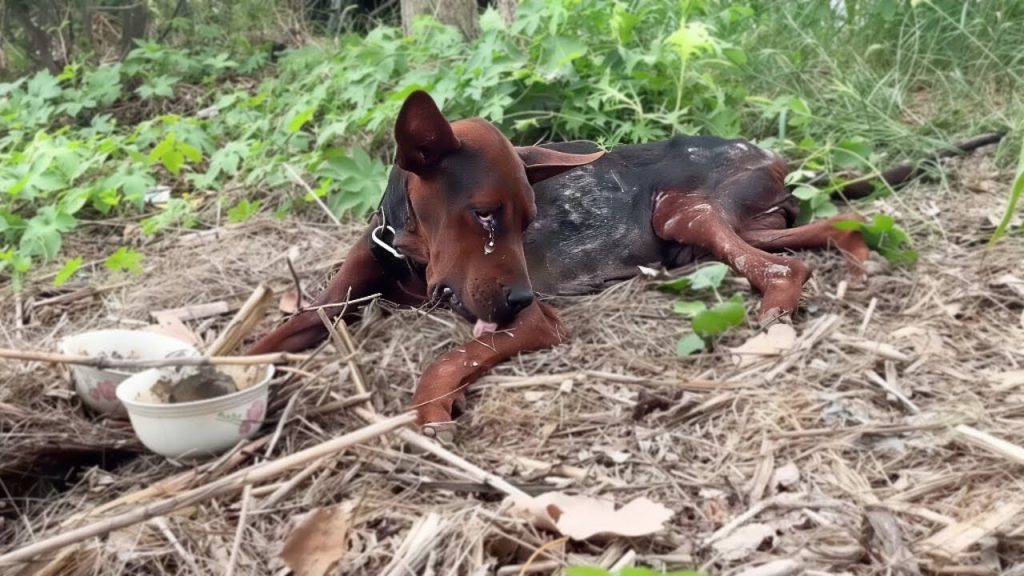
His chain didn’t just bind him physically—it symbolized the cruelty of being forgotten. The sun scorched his skin day after day, and the rare scraps of food he received every few days eventually stopped altogether. There was no shelter, no mercy, no kindness—just heat, hunger, and silence. By the time rescuers arrived, alerted by a desperate neighbor who could no longer bear to witness Hongyu’s suffering, the big dog had become gaunt, his ribs protruding, his body covered in sores and patches of raw, sunburned skin. He was lying motionless, dangerously close to death, his breathing shallow, his eyes barely responsive.
The rescuers acted swiftly. The first priority was to cool his body down to bring his temperature under control. Towels soaked in water were gently laid on his sun-scorched skin. They spoke to him softly, not knowing if he could hear them, but hoping the sound of a gentle human voice might offer even the faintest sense of comfort. Slowly, with care and patience, Hongyu was lifted from the ground and brought to safety.
Back at the rescue facility, Hongyu’s recovery began with the essentials—hydration, nourishment, and rest. He was given clean water and a modest meal, which he devoured with surprising energy. Despite his critical condition, he still had the will to eat. It was a hopeful sign. Over the next few days, he was fed small, nutrient-rich meals to help his system recover. His body, once starved and weak, needed time to adjust, but he responded well. The most urgent concern was his skin, which had been severely damaged by prolonged sun exposure and neglect. Medicated baths were introduced as part of his daily routine. They were soothing and healing, helping to clean the open sores and alleviate the pain. A gentle ointment was applied afterward to encourage healing and relieve inflammation.
Hongyu never once resisted. He stood patiently during his baths, accepting the hands that washed him as though he somehow understood that they meant no harm. For a dog that had known only neglect and abandonment, his capacity to trust again was astonishing.
One of the most heartbreaking details of his story came not from his condition, but from the resistance his rescuer initially faced. A kind neighbor had offered to buy Hongyu from his owner, simply to save him from this life of misery. But the owner declined, insisting the dog remain to guard the empty property—despite the fact that no one lived there anymore, and despite the obvious suffering Hongyu was enduring. Only when it became clear that the dog might not survive did the neighbor call for professional help. It was a last act of compassion, and it may have saved his life.
As days turned into weeks, Hongyu’s condition steadily improved. His wounds began to close. His eyes grew brighter. His tail, once limp and lifeless, began to wag in small, hesitant movements. And with each passing day, his spirit seemed to return. He learned to walk again with strength and purpose, his steps slow but determined. Volunteers noticed how incredibly sweet he was—calm, gentle, and obedient. There was no aggression, no fear, only a quiet grace that touched everyone who met him. He allowed people to approach, to touch, to care for him, as if he still believed that somewhere in the world, love could exist for him.
Nutrition played a key role in his physical comeback. Hongyu was given a specialized diet tailored to support muscle rebuilding and weight gain. His body, once frail and vulnerable, gradually regained its strength. Over time, his fur began to grow back in soft patches. The raw wounds that had once defined his appearance were replaced by healthy skin. He was transforming—not just physically, but emotionally. The haunted look in his eyes faded, replaced by curiosity, hope, and even joy.
Perhaps the most remarkable part of Hongyu’s journey wasn’t just his survival—but his spirit. He had every reason to give up on humans, to fear them or reject them. Yet he didn’t. In his quiet way, he forgave. He welcomed the chance at a new life. And in doing so, he gave those around him a deeper understanding of resilience, of grace, and of how healing begins—not just with medicine or food, but with compassion.
Hongyu’s story is not unique, sadly. There are countless animals across the world who suffer silently, tucked away in forgotten corners, waiting for someone to care. But his journey stands as a powerful reminder of what can happen when someone decides to act. The neighbor who refused to look away. The rescue team that worked tirelessly to save him. The volunteers who showed him love every day. These moments—small in themselves—came together to form a lifeline.
For those who follow his story, Hongyu is more than a rescue dog. He is a symbol of quiet endurance, of a soul who waited for kindness and found it just in time. His recovery reminds us that neglect may wound the body, but love can still mend the heart.
And in that truth lies the real message of this story: that no creature is ever too far gone to be saved, and no act of compassion is ever too small to matter.