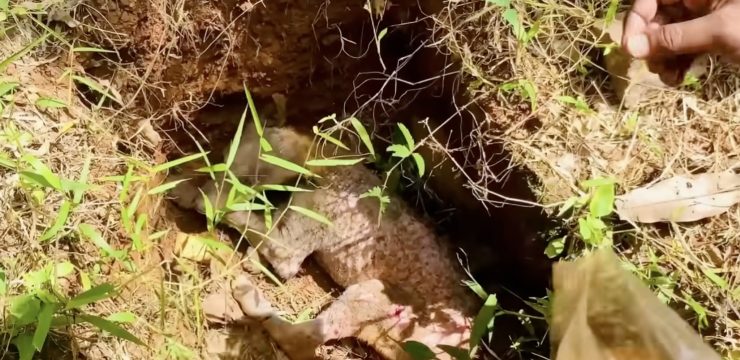
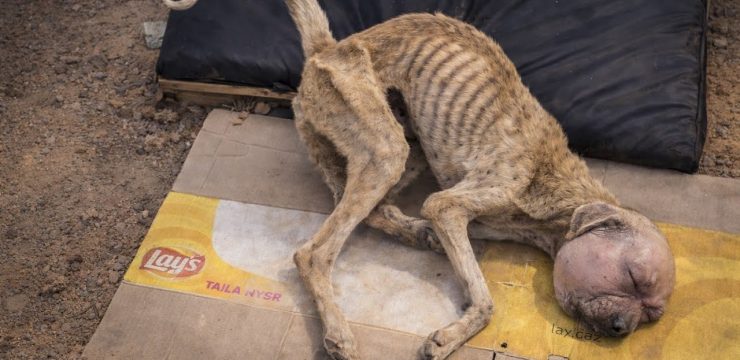
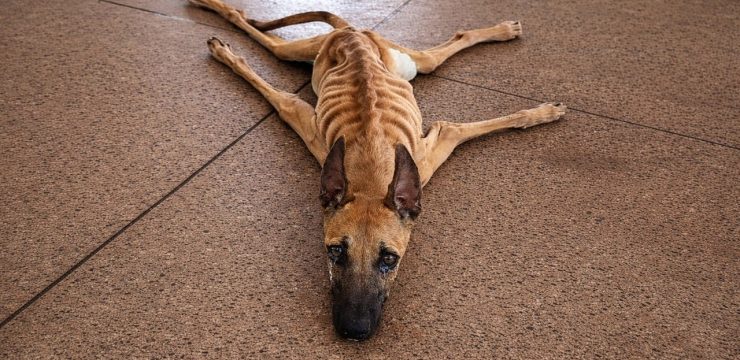
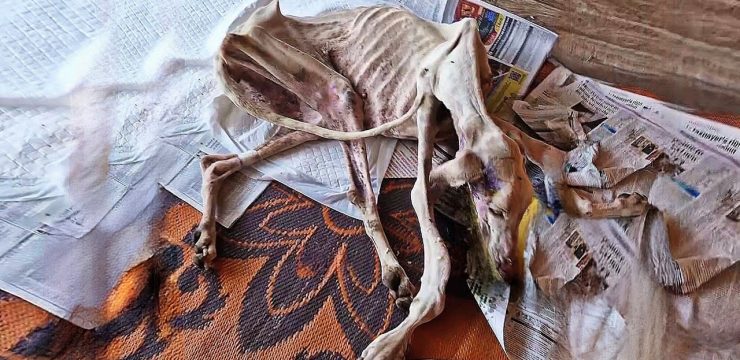
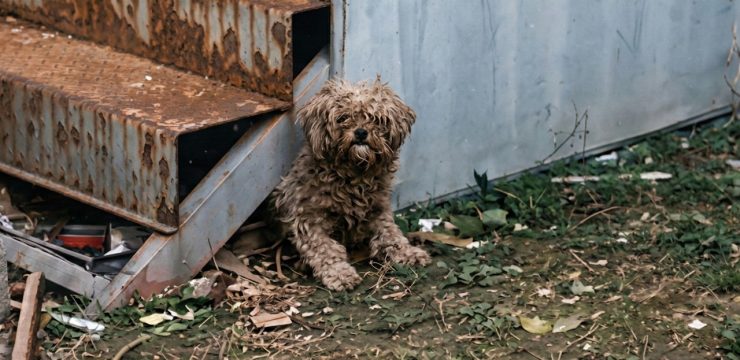
Dairn’s story is not simply about survival. It is about what can happen when compassion refuses to give up, even when every professional opinion says it is time to let go. For years, this gentle dog endured a life no living creature should ever know—confined inside a cramped cage, deprived of freedom, comfort, and basic dignity. Her world was small, cold, and unchanging. Day after day, she existed in isolation, her body weakening and her spirit slowly dimming under the weight of neglect.
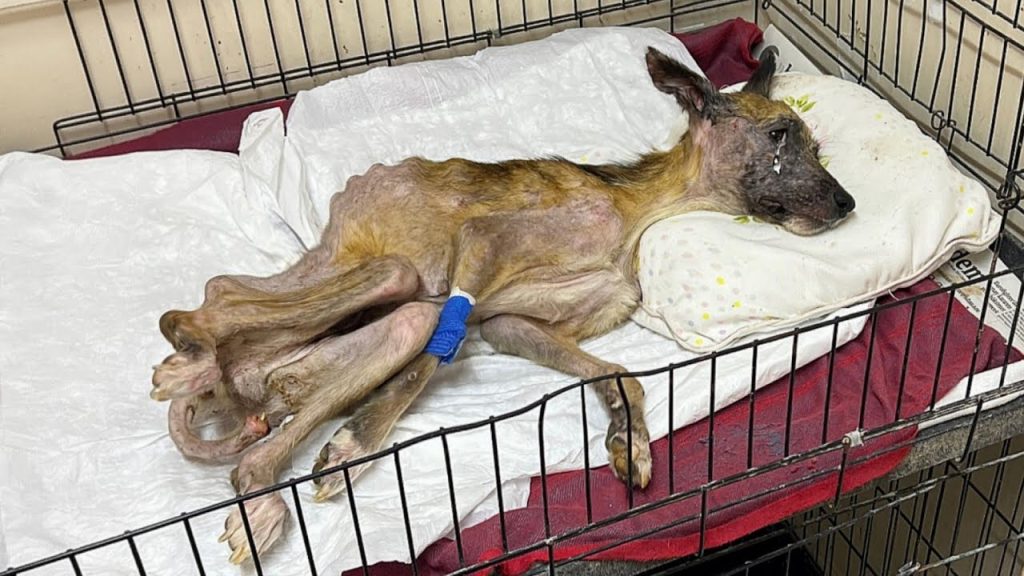
When rescuers finally found her, they knew she had suffered. What they did not yet understand was how deeply that suffering had carved itself into her body. Medical examinations revealed devastating news. Dairn was not only malnourished and physically frail; she had severe brain damage and serious injuries to her spinal cord. The damage was so extensive that even seasoned veterinarians struggled to process what they were seeing. Her prognosis was grim. The recommendation that followed was one no animal lover ever wants to hear: euthanasia.
It would have been the easier path. It would have spared her from further procedures and spared her rescuer from heartbreak. But sometimes the easiest decision is not the one love allows us to make. Dairn’s rescuer looked at her fragile body and did not see a lost cause. She saw a life still present, still worthy, still fighting in its own quiet way. Instead of accepting the final recommendation, she chose to fight.
Dairn underwent professional medical treatment. Specialists did what they could. Medications were administered. Therapies were attempted. Every reasonable intervention was explored. Yet despite these efforts, improvement seemed painfully limited. Eventually, the doctors made a difficult call. They believed there was nothing more they could do. Dairn was sent home, not because she was healed, but because the expectation was that she would pass peacefully in a familiar place.
What happened next defied medical logic.
Back at home, surrounded by warmth instead of steel bars, Dairn received something no hospital could prescribe: constant, loving care. Her rescuer did not treat her as a patient waiting for the end. She treated her as family. She spoke to her softly. She kept her comfortable. She cleaned her gently and ensured she was never alone. Meals were given with patience. Nights were spent watching her breathe, celebrating even the smallest signs of stability.
Slowly, almost imperceptibly at first, Dairn’s condition began to stabilize. The downward spiral halted. Her body, once expected to fail completely, started holding on. While the severe damage to her brain and spinal cord would never fully reverse, her vital signs strengthened. She remained with them. Days turned into weeks. Weeks turned into months. The miracle was not dramatic or sudden; it was steady and persistent.
There was, however, one reality that could not be undone. Dairn would never walk on her own again. The injuries to her spine had permanently taken that ability from her. For some, that might have signaled the end of hope for a normal life. But her rescuer understood something powerful: mobility does not define worth.
Instead of mourning what Dairn could no longer do, she focused on what was still possible. A custom wheelchair was designed specifically for Dairn’s body. It fit her frame carefully, supporting her in a way that felt secure rather than restrictive. At first, she was unsure. The new device was unfamiliar. But with patience, encouragement, and repetition, she began to learn. Step by step, supported by wheels instead of hind legs, Dairn discovered movement again.
The first time she propelled herself forward, it was not graceful. It was slow and slightly awkward. But it was hers. It was independence rediscovered in a new form. Over time, she gained confidence. The dog who had once known nothing but confinement now rolled across open spaces, feeling grass beneath her front paws and air against her face. Her eyes, once dull from exhaustion and despair, began to show curiosity and even joy.
Today, Dairn’s life looks nothing like her beginning. She is not defined by her disabilities or by the cruelty she endured. She is a cherished member of her family. She participates in daily routines. She enjoys affection. She experiences safety, something she was denied for so long. While she will always require special care, that care is given freely and lovingly.
Her story offers a message that resonates deeply, especially for those who understand perseverance. Love does not always restore what was lost. It does not always erase damage or rewrite history. But love can create a future where there once seemed to be none. It can transform a prognosis of hopelessness into a life filled with meaning.
For many of us, particularly those who have seen life’s hardships up close, Dairn’s journey feels familiar in a symbolic way. There are seasons when we are told that something cannot be saved. There are moments when circumstances seem final. Yet resilience, supported by devotion, can lead to outcomes that no chart or report could predict.
Dairn will never run freely on four legs. She will never experience the ease of natural movement. But she lives. She feels comfort. She knows belonging. And perhaps most importantly, she knows she was worth fighting for.
In a world where it is often easier to turn away from broken things, Dairn’s life stands as quiet proof that persistence and compassion can carry even the most fragile soul through darkness and into light.