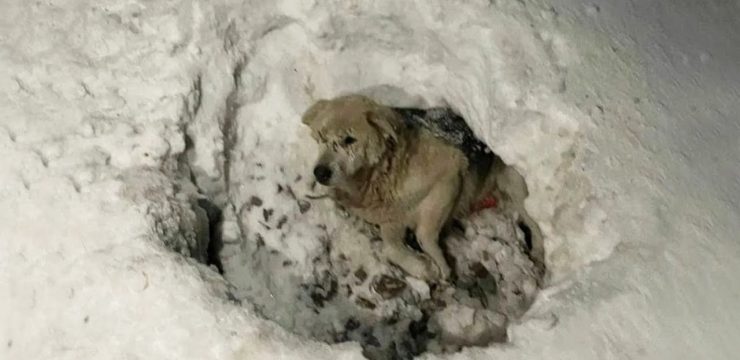
Rain fell in a steady, indifferent rhythm, turning the edge of a busy highway into a shallow, muddy stretch of water. Cars rushed past without slowing, their tires slicing through puddles, their drivers unaware—or unwilling to see—what lay just feet away from the road. In that cold, unforgiving place, a dog named Maddox lay motionless, his body partially submerged, his eyes dim with exhaustion. He did not try to move. He did not cry out. It was as if he had already accepted that no one was coming.
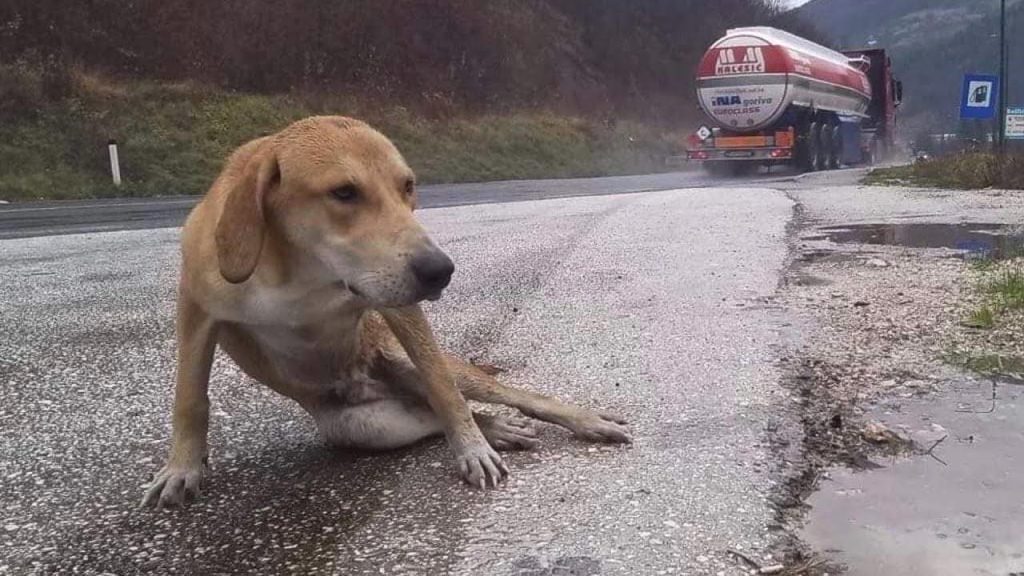
At first glance, he looked like he had simply collapsed from fatigue. But a closer look revealed something far more serious. His back legs lay still, unresponsive, stretched awkwardly behind him. The rain soaked through his fur, chilling him to the bone, while passing vehicles sent small waves of dirty water washing over his fragile body. Anyone who stopped long enough to see him would have recognized the quiet desperation in his eyes—the kind that comes from pain, confusion, and the slow fading of hope.
When help finally arrived, it came quickly and without hesitation. The rescuer who found Maddox did not pause to question whether he could be saved. There was no calculation, no weighing of odds—only action. Gently lifting his limp body from the puddle, the rescuer could feel how little strength remained. Maddox did not resist. He simply rested his head, as if surrendering himself completely to whatever would happen next.
At the clinic, the reality of his condition became clear. Maddox had suffered severe spinal trauma, most likely from being struck by a fast-moving vehicle. The damage was extensive, and the prognosis was grim. Even among experienced professionals, there was uncertainty. One specialist, after reviewing his condition, expressed deep concern and initially declined to perform surgery. The chances of success were painfully low, and the risks were significant.
But the rescuer refused to accept that answer.
Standing in that sterile, brightly lit room, the rescuer pleaded for Maddox’s life—not with anger, but with unwavering belief. There was still a chance, however small, and that chance mattered. After careful reconsideration, the surgeon agreed to proceed. It was not a promise of recovery. It was simply an opportunity—one that few in Maddox’s condition ever receive.
The surgery was long and complex, requiring precision, patience, and hope. Every movement carried weight, every decision mattered. When it was over, Maddox was placed in recovery, his body fragile, his future uncertain. The days that followed were filled with quiet tension. Each small sign was observed closely, each moment measured against expectations that were already low.
By the sixth day, there was little to celebrate. Maddox showed no response to deep pain tests, a critical indicator that often determines long-term mobility. The veterinary team spoke carefully, choosing their words with compassion. It was likely, they said, that Maddox would never walk again. A wheelchair could give him some quality of life, but independence might remain out of reach.
For many, that would have been the end of the story.
But Maddox was not ready to stop fighting.
There was something in him—something quiet but unbreakable—that refused to fade. Though his body remained weak, his spirit did not follow the same path. He continued to eat when encouraged, to lift his head, to stay present. And those small, almost invisible efforts began to add up.
Then, on a day that began like any other, something changed.
It did not happen dramatically. There was no sudden transformation, no loud moment of triumph. Instead, it came in a simple, almost unbelievable act. Maddox pushed against the ground. His legs, once completely still, responded. Slowly, with visible effort, he lifted himself upward. For the first time since the accident, he stood on all four legs.
The room fell quiet, not from shock alone, but from the realization of what they were witnessing. This was not supposed to happen. Not according to the tests. Not according to experience. And yet, there he was—unsteady, fragile, but standing.
That moment did not erase everything that came before it. Maddox still faced a long road of recovery, filled with challenges that could not be ignored. But it changed something essential. It proved that even in the most difficult circumstances, there is space for possibility.
His story is not just about survival. It is about persistence in the face of overwhelming odds. It is about the power of compassion—the kind that refuses to walk away, even when the outcome is uncertain. And perhaps most of all, it is about the quiet strength that can exist within even the most vulnerable lives.
Maddox did not ask for help. He did not know if help would come. But when it did, he met it with a resilience that continues to inspire everyone who hears his story.
Somewhere along a busy highway, in the middle of the rain, a life that seemed to be slipping away was given another chance. And against all expectations, that chance was enough.