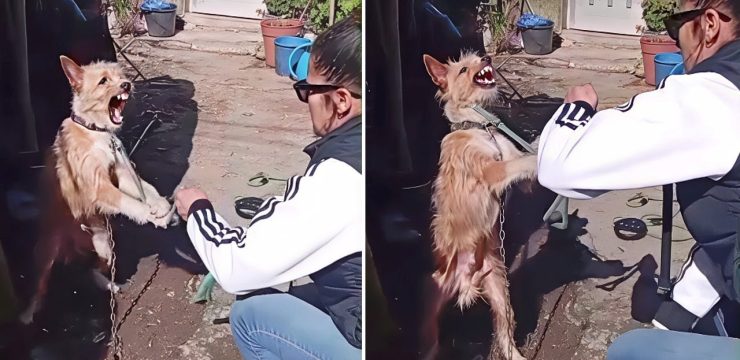
In a forgotten corner of a small town, a dog named Hongyu stood as a symbol of unwavering loyalty — even in the face of betrayal. He had once been a beloved companion, a guardian of the home, full of life and trust. But when his family packed up and moved away, they left something behind: not just memories, but Hongyu himself — chained, alone, and forced to remain behind to “protect” an empty house.
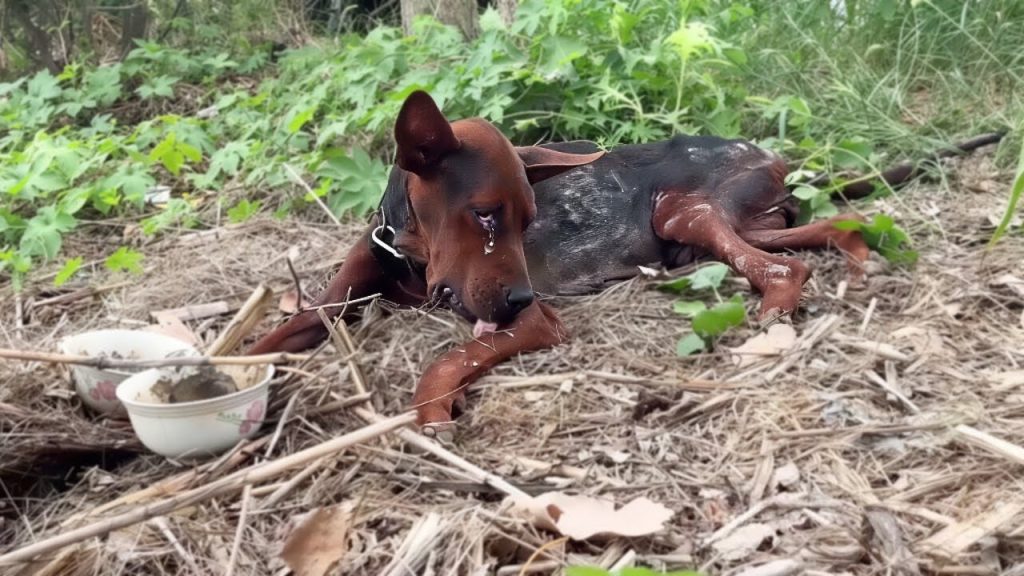
For days, possibly weeks, Hongyu endured the blistering heat with no consistent source of food or water. The relentless sun scorched his skin, leaving it raw and painfully burned. His once-strong frame grew frail, his ribs visible beneath a coat thinned by neglect. He waited, faithfully, for the family he loved — but no one came. Passersby saw him, and one kind neighbor even offered to buy him just to give him a chance at survival. But the response was cold and firm: Hongyu was to stay, guarding the property, no matter the cost to his well-being.
By the time help arrived, it was almost too late. Hongyu’s condition was heartbreaking. His body was limp, nearly unresponsive. His eyes were vacant, the result of heatstroke and exhaustion. But somewhere deep inside, a spark of trust still lingered. When rescuers approached and gently laid a hand on his back, he didn’t growl or flinch — he leaned in. He remembered kindness.
The rescue team acted quickly. They moved him out of the sun and began a cooling process to lower his dangerously high body temperature. His skin, covered in painful sores, required careful treatment. Gentle medicated baths were given regularly, each one not just a step toward healing, but a small moment of comfort. His diet was slowly rebuilt with high-nutrition meals designed to restore the strength he had lost.
What stood out most wasn’t just his recovery — it was his spirit. Despite the cruelty he had endured, Hongyu never lost his gentle nature. He didn’t show fear or anger. He simply looked up at those caring for him with eyes that still held hope. There was a softness in him that couldn’t be broken, a resilience that spoke to the depth of a dog’s love and loyalty.
Each day, Hongyu grew stronger. His body, once skeletal, began to fill out. His wounds started to close. But the healing that happened wasn’t just physical. As the days turned into weeks, Hongyu began to wag his tail again. He started to trust more fully, to play, and to rest without fear. He found peace not in a house to guard, but in the arms of people who truly saw him — not as a possession, but as a life worth saving.
Today, Hongyu is no longer that abandoned soul clinging to hope in the heat. He is safe. He is recovering. His story is a reminder of how deeply animals can feel, how long they can wait for love, and how quickly they forgive — even when forgiveness is never earned. What was done to Hongyu cannot be undone, but what can be done — what was done — was to show him that his life matters, and that love, even when delayed, can still arrive in time.
There are many stories in the world about rescue. Some are loud, dramatic, filled with urgency. But Hongyu’s is quiet. It’s the story of a dog who stood guard over a place where no one would return, not because he had to — but because he believed he should. It’s the story of how neglect can strip a being of health and dignity, yet how simple acts of compassion can restore both.
For those of us who have known the loyalty of a dog, Hongyu’s story cuts deep. It challenges us to look closer at the animals around us — the ones who ask for so little yet give so much. It reminds us that guardianship goes both ways. We don’t just bring animals into our homes to protect us, comfort us, or keep us company. We also take on the sacred duty to protect them, especially when their voices can’t be heard.
Hongyu’s journey is not just about survival; it is about grace. He endured what no living being should ever endure. Yet, he emerged not bitter, not broken, but open — open to touch, to healing, to love. And that kind of spirit is something we can all learn from.
As he continues to recover, Hongyu carries with him a quiet strength and a lesson that will outlast scars and sunburn. He reminds us that abandonment doesn’t define a life — rescue does. What matters most is not what was done to him, but what was done for him. And perhaps, in the eyes of every rescued dog like Hongyu, we can find a reflection of what it means to be human — not just to feel, but to act, to care, and to choose kindness when it matters most.