Felix was only three years old when his body told a story no animal should ever have to live through. The slender Podenco, a breed known for its elegance and agility, had been reduced to what rescuers described as a walking skeleton. His ribs pressed sharply against fragile skin, his hips protruded painfully, and every step looked like it might be his last. It was almost impossible to comprehend how such a young dog could be brought so close to the edge of survival.
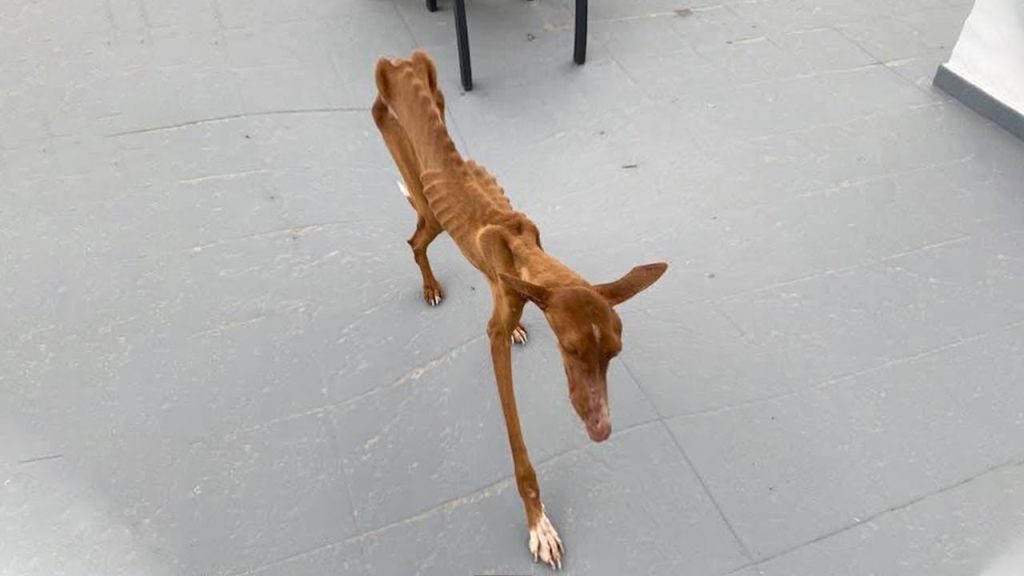
What makes Felix’s story even more remarkable is the way it began to change. In what can only be described as a final act of courage, he gathered the little strength he had left and staggered toward a group of people who were out walking their own dogs. His legs trembled beneath him, his body swaying as though a single gust of wind could knock him down. Yet somehow, he kept moving. There was something in his eyes—a quiet plea, a flicker of hope—that spoke louder than any bark ever could.
Those who saw him that day immediately understood that he was in critical condition. It was nothing short of a miracle that he was still able to stand. Severe neglect had stripped him of nearly all body fat and muscle. Every bone was visible. His once-athletic frame had become frail and hollow, as though time itself had been draining him away. For a dog bred for endurance and speed, this was a heartbreaking contrast.
Once he was safely brought into care, the urgency of his condition became even clearer. Veterinary professionals acted quickly, running blood tests to assess internal damage and taking X-rays to evaluate his weakened skeletal structure. Parasites, common in cases of prolonged neglect, had further compromised his health and required immediate treatment. Each procedure was performed with care, knowing how fragile he truly was.
The road to recovery was not going to be quick or simple. Felix needed rest above all else. His body had endured prolonged deprivation, and rebuilding it would require patience and precision. He was introduced to small, carefully measured meals designed to nourish him without overwhelming his system. Simple foods like chicken became part of his daily routine, providing easily digestible protein to help restore muscle mass. Every bite represented progress.
But nourishment alone was not enough. Felix also needed reassurance. Gentle hands, soft voices, and a calm environment became essential components of his healing. Trauma does not disappear overnight, and animals who endure severe neglect often carry invisible scars alongside the visible ones. Those caring for him understood that emotional safety was just as important as physical treatment.
Day by day, subtle changes began to appear. His legs, once shaky and uncertain, slowly regained strength. At first, he could only manage short, cautious movements. Then those steps became steadier. The hollow look in his eyes softened as his body responded to consistent care. Weight began to return to his frame, filling out the sharp edges that had once defined him. During the initial phase of his recovery, Felix gained five kilograms—a significant milestone that signaled his body was finally rebuilding itself.
Watching that transformation unfold was deeply moving. The same dog who had once looked too weak to survive was gradually revealing his natural grace again. His coat began to look healthier. His posture grew more confident. The fragile figure who had staggered toward strangers in desperation was now standing taller, stronger, and more secure.
Stories like Felix’s remind us how resilient animals can be when given a chance. They also serve as a quiet call to compassion. Neglect leaves lasting damage, but timely intervention can rewrite a life’s trajectory. It takes awareness, willingness, and often the bravery of bystanders who choose not to look away.
By the end of his recovery journey, Felix no longer resembled the skeletal dog who had once been fighting simply to remain upright. He had become a handsome, healthy Podenco again—alert, balanced, and full of quiet dignity. The change was not just physical. There was a renewed light in his eyes, a sense that he finally understood he was safe.
Perhaps the most comforting part of all is knowing that Felix’s story did not end in uncertainty. A forever family was already waiting, prepared to welcome him into a stable and loving home. For a dog who once had nothing but fading strength and a desperate hope, that promise represents everything.
Felix’s journey is both heart-wrenching and inspiring. It reminds us that even in the face of extreme hardship, the will to survive can shine through. More importantly, it shows how compassion, medical care, and steady dedication can transform what seems like a hopeless situation into one filled with possibility. For anyone who has ever wondered whether a single act of kindness can make a difference, Felix stands as living proof that it absolutely can.