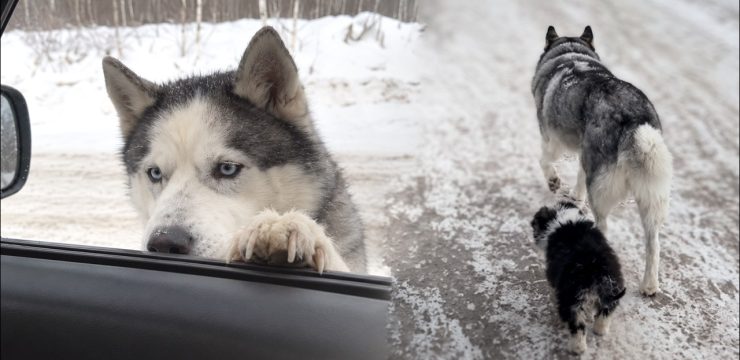
Standing alone in the middle of a busy road, an elderly dog named Shiyi seemed frozen in confusion and fear. Cars passed by, drivers swerved, and the world rushed on as if she were invisible. Someone had left her there—left her at an age when she needed comfort the most. She did not bark or run. She simply stood, helpless and disoriented, as though waiting for a familiar voice that would never return.

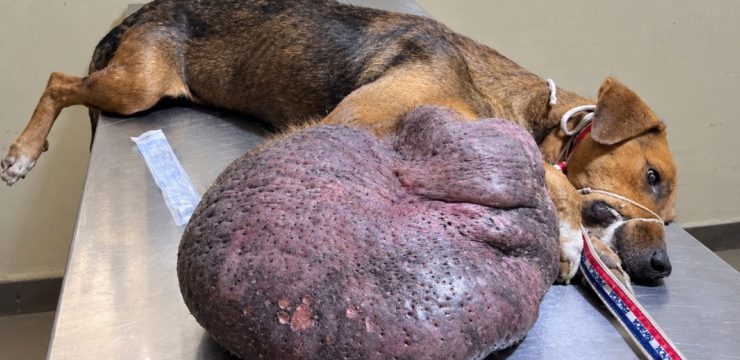
When her rescuer first approached, it was clear that Shiyi’s body told a story of hardship. She was thin, fragile, and exhausted. But it was the large bulge along her abdomen that caused immediate concern. What looked at first like swelling from neglect turned out to be something far more serious. A veterinary examination confirmed that Shiyi was suffering from a severe inguinal hernia. The condition was not only visible; it was deeply painful. It interfered with her ability to move comfortably and made even the most basic bodily functions difficult.
As heartbreaking as that diagnosis was, it was only the beginning. Further testing revealed that Shiyi’s health was far more compromised than anyone had imagined. Her kidneys were failing. Her body showed signs of severe inflammation. Complications associated with advanced age had taken hold, weakening her system from the inside out. The reality was sobering. Shiyi was not simply an abandoned dog in need of shelter; she was a medically fragile senior fighting multiple serious conditions at once.
For her rescuer, the situation quickly became an emotional crossroads. Surgery could potentially repair the hernia and relieve some of her pain. But anesthesia posed an enormous risk. With her kidney failure and overall frailty, there was a real possibility that she would not survive the procedure. On the other hand, choosing not to operate meant allowing the hernia to continue causing discomfort and limiting her quality of life. It was a decision no compassionate person ever wants to face.
This is the silent weight that animal rescuers carry. Love alone cannot erase illness. Devotion cannot always reverse the effects of age and neglect. Sometimes the most loving choice is not the most aggressive one, but the one that considers dignity, comfort, and peace. In Shiyi’s case, every option carried uncertainty. There were no guarantees—only hope, tempered by realism.
Despite the grim prognosis, her rescuer made one promise that required no medical approval and no signed consent forms. Shiyi would not be alone again. However long she had left—whether weeks, months, or only days—she would spend it surrounded by warmth, safety, and gentle care. She would feel a soft bed beneath her tired body instead of asphalt. She would hear kind voices instead of traffic. She would know, perhaps for the first time in a long while, that she mattered.
There is something especially tender about senior dogs. They move more slowly. Their eyes carry stories we can only imagine. They do not ask for much—just a quiet place to rest, a hand to stroke their fur, a presence that assures them they are safe. To see a dog of advanced age abandoned on a road is more than neglect; it is a breaking of trust. Dogs remain loyal until their last breath. They do not walk away from us when we become inconvenient. They stay.
Shiyi’s condition is a stark reminder of the responsibility that comes with bringing an animal into our lives. Pet ownership is not a temporary arrangement or a seasonal decision. It is a lifelong commitment that extends into the gray years, when veterinary bills may rise and energy may fade. Compassion does not expire when youth does. In many ways, those later years are when compassion matters most.
At the same time, her story shines a light on the extraordinary impact of one caring individual. A single decision—to stop the car, to approach gently, to take responsibility—altered the final chapter of Shiyi’s life. Even if medicine cannot offer a cure, love can still offer comfort. Even when time is limited, dignity can be preserved. That matters more than many realize.
For readers who have loved animals across decades, Shiyi’s story may stir familiar emotions. Perhaps you remember holding a graying muzzle in your hands. Perhaps you have faced the painful balance between medical intervention and peaceful rest. These moments are never easy. Yet they are part of the sacred bond we share with our pets. We owe them safety, care, and presence—especially when their bodies grow weak.
Shiyi’s journey is not just about illness or abandonment. It is about what happens next. It is about the choice to respond with kindness instead of indifference. It is about ensuring that, regardless of outcome, a vulnerable life is treated with respect. In a world that sometimes moves too quickly, her rescue invites us to slow down and notice the quiet souls who depend on us.
No one can predict how long Shiyi will have. What can be known with certainty is this: she will not face her remaining days alone. She will be touched with gentle hands. She will be spoken to softly. She will rest without fear. And in that promise lies the true measure of compassion.
Her story asks each of us a simple but profound question: when responsibility calls, will we turn away—or will we step forward with care?