The sound reached her before the sight ever did.
It began as a soft, refined hum—three engines moving in quiet harmony, unlike anything that usually passed through that worn-down street. For a moment, it didn’t even feel real. The neighborhood was used to rattling buses, aging sedans, and the occasional delivery truck. Not this. Never this.
Then came the impossible image.
A white Rolls-Royce glided into view, followed closely by a sleek black one, and then another white car just as pristine as the first. They pulled up one after another along the cobblestone sidewalk, their polished surfaces reflecting the muted tones of old brownstone buildings and bare winter trees. The cars looked like they belonged somewhere else—somewhere far removed from this quiet, modest corner of the city.
Shiomara Reyes froze mid-motion.
Her hand, still gripping a ladle, hovered above a large pot of yellow rice. Steam curled upward, brushing against her face like a familiar memory—warm, comforting, grounding. Her apron, stained with saffron and oil from years of honest work, clung to her as she blinked, trying to make sense of what she was seeing.
Her first thought was simple: this had to be a mistake.
Maybe a film crew. A wedding party. Something staged. Something temporary. Because people like that—people who stepped out of cars like those—didn’t come here. Not to her small food stall, tucked between aging buildings and cracked sidewalks.
But then the engines went silent.
The doors opened, slow and deliberate, and three individuals stepped out.
They didn’t rush. They didn’t look around in confusion or curiosity. Instead, they moved with a quiet confidence, as if the world itself had arranged this moment just for them. Two men and one woman. Their clothes were immaculate, tailored with precision. Their shoes barely made a sound against the stone beneath them.
Their eyes didn’t wander to the storefronts or passersby.
They went straight to the cart.
The simple metal cart, where large trays held roasted chicken, seasoned vegetables, rice, and neatly wrapped tortillas. The same cart Shiomara had stood behind for years. The same cart that had fed countless people who had nowhere else to go.
She instinctively brought her hands toward her mouth, her breath catching somewhere deep in her chest.
Suddenly, everything else faded.
The distant honking of cars. The cold air slipping through the collar of her faded blouse. Even the knife she had set down moments earlier—all of it seemed to disappear into a blur. Time narrowed into a single, quiet moment stretching between her and the three strangers walking toward her.
Her heart began to pound, loud and unsteady.
And with it came a question she had buried long ago. A question she refused to dwell on because survival didn’t leave room for regret.
What did I do wrong?
The thought surfaced uninvited, sharp and familiar.
Life had not been kind to Shiomara. She had worked tirelessly, day after day, feeding others even when her own cupboards were nearly empty. She had given what little she had, not because she had extra, but because she understood what it meant to go without.
Still, life had remained hard.
So when she saw wealth like that—effortless, polished, distant—it stirred something deep inside her. Not envy, but a quiet ache. A wondering.
The three figures stopped just a few steps away from her cart.
The man on the left wore a dark brown suit. He had a short beard, neatly trimmed, and a smile that seemed uncertain—like he wanted to be composed, but something inside him made it difficult. The man in the center stood tall in a deep blue suit, his tie understated but elegant. He swallowed hard, as if steadying himself for something important.
And the woman.
She stood slightly forward, her gray hair falling loosely around her shoulders. There was strength in her posture, but also something softer—something carried quietly over the years. Her expression was calm, but her eyes held a depth that spoke of experience, of memories that had shaped her in ways words could not fully capture.
She placed a hand gently against her chest.
For a moment, no one spoke.
The air between them felt heavier than before, filled with something unspoken yet deeply significant.
Shiomara tried to greet them, to offer the same warm “Good morning!” she had given to every customer who approached her stall over the years. But when she opened her mouth, no words came out. Just a faint breath, barely audible.
Her voice had abandoned her.
The silence stretched, not uncomfortable, but meaningful. As if all four of them were standing at the edge of something that had taken years—perhaps decades—to arrive.
The man on the left took a small step forward.
His smile softened, becoming more genuine now, though his eyes shimmered slightly with emotion. The man in the center glanced briefly at the woman, then back at Shiomara, as though drawing strength from the shared moment.
But it was the woman who finally spoke.
Her voice was steady, yet gentle, carrying a warmth that felt familiar in a way Shiomara couldn’t immediately place.
“You may not remember us,” she said softly.
The words lingered in the air, stirring something deep within Shiomara’s memory.
And suddenly, without warning, the past began to rise.
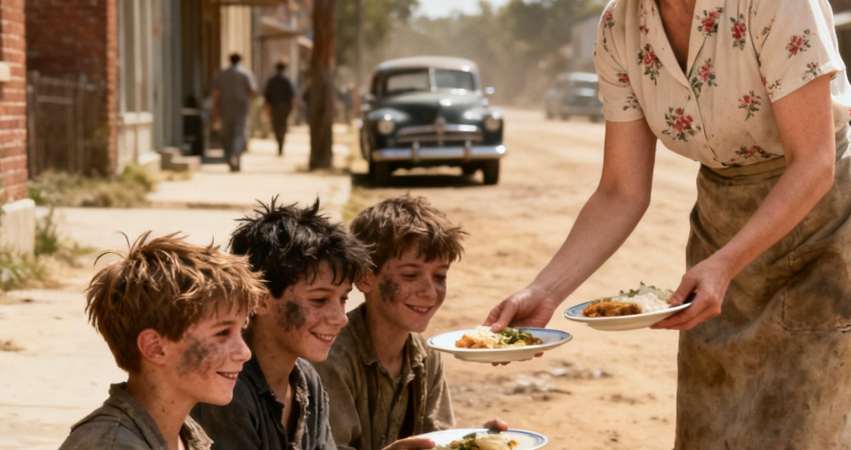
Three small faces. Thin. Tired. Hungry.
Triplets.
They had come years ago—children who barely spoke, who stood close together as if the world might pull them apart if they let go. They had no money. No place to go. Just quiet eyes and empty hands.
And she had fed them.
Not once. Not twice. But over and over again, whenever they showed up at her stall. She never asked questions. Never demanded anything in return. She simply gave them food, the same way she would have wanted someone to help her if the roles had been reversed.
She had forgotten their names over time.
But she had never forgotten their eyes.
Now those same eyes stood in front of her—older, stronger, shaped by time but unmistakably the same.
Her breath caught again, but this time it was different.
Not confusion. Not fear.
Recognition.
The woman’s hand remained over her heart as she took another step closer.
“We never forgot,” she said.
And in that moment, everything made sense.
Not the cars. Not the wealth. Not the years in between.
But the connection.
The quiet, powerful truth that kindness—no matter how small it may seem in the moment—never truly disappears.
It waits.
It grows.
And sometimes, when you least expect it, it comes back in ways you could never have imagined.