A quiet white dog once lived in conditions no living creature should ever have to endure. He was found chained on a short leash, unable to move freely, left out in the cold with nothing but spoiled food and filthy water nearby. His world was small, harsh, and lonely. There was no warmth, no comfort, and no sign that anyone had ever shown him kindness. When rescuers finally arrived, they didn’t just find a neglected animal—they found a soul that had completely withdrawn from the world.
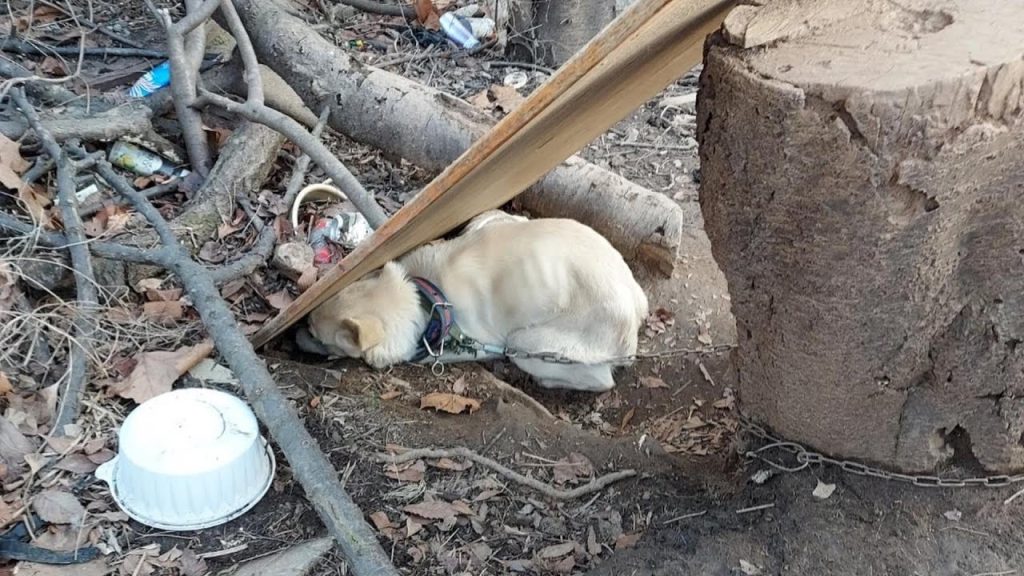
He was trembling, not only from the cold but from fear that seemed to run far deeper than his fragile body. The moment anyone came close, his eyes would shift away, as if he had already learned that looking at humans brought no comfort. He did not bark. He did not resist. He simply existed in a quiet state of survival, unsure of what would come next. It was the kind of silence that speaks volumes, the kind that tells a story of long days without care and nights without hope.
After being rescued, he was gently transported to a veterinary clinic where professionals could finally assess his condition. Surprisingly, despite everything he had been through, his physical health was not as dire as expected. He had been deprived and neglected, but his body had somehow endured. It was his emotional state that carried the deepest wounds. Trauma had settled into him, shaping his behavior and distancing him from any sense of safety.
They gave him a name—Jindol. It was the first step in giving him an identity beyond his past. But a name alone could not undo what he had experienced. In those early days, Jindol would retreat to the corners of his enclosure, curling into himself as if trying to disappear. He spent long hours staring at the wall, motionless, detached from everything around him. When food was offered, he would wait until no one was nearby before cautiously approaching it, as though even nourishment came with risk.
Those who cared for him understood that healing would not come quickly. They did not force interaction. They did not overwhelm him with attention. Instead, they offered something far more powerful—patience. They sat nearby without expectation, allowing him to grow accustomed to their presence at his own pace. They spoke softly, moved gently, and respected the boundaries he had built as protection.
Days turned into weeks, and slowly, almost imperceptibly, small changes began to emerge. Jindol’s posture softened. His eyes, once distant and vacant, started to show flickers of awareness. One day, he accepted a treat directly from a caregiver’s hand. It was a simple act, but for him, it marked a significant breakthrough. Trust, once broken, was beginning to rebuild itself, piece by fragile piece.
As time passed, Jindol became more curious about the world around him. Toys that once went unnoticed began to catch his attention. He would nudge them gently, unsure at first, then with growing confidence. Interactions with other rescued dogs became part of his daily routine. At first, he observed from a distance, watching how they played and moved freely. Eventually, he took small steps toward them, engaging in brief moments of connection that would have been unthinkable in his earlier days.
Each milestone, no matter how small, was celebrated quietly by those who had stood by him. They knew that healing from emotional trauma is not measured in leaps, but in subtle shifts—an extra glance, a relaxed posture, a willingness to stay close rather than retreat. Jindol was learning that the world could be different from what he had known.
About a month after his rescue, a new opportunity appeared—one that would change everything. A loving family stepped forward, ready to give him the life he deserved. They saw beyond his fear and recognized the gentle spirit waiting to emerge. With careful consideration and hope in their hearts, they welcomed him into their home and gave him a new name: Henry.
The transition into a home environment can be overwhelming for a dog who has known only hardship, but Henry’s story was already one of resilience. Surrounded by warmth, consistency, and affection, he continued to grow in ways that once seemed impossible. His new family provided not only safety but also understanding. They allowed him the space he needed while gently encouraging him to explore, to trust, and to feel secure.
Over the following weeks, the transformation became undeniable. Henry began to enjoy simple pleasures—walking on a leash without fear, feeling the grass beneath his paws, and breathing in fresh air without tension. At the park, he moved with a sense of freedom that contrasted sharply with his earlier days. His body language changed completely; where there had once been hesitation, there was now confidence.
Perhaps the most powerful change was in the way he looked at his family. His eyes, once filled with uncertainty, now reflected trust. He followed them with calm assurance, leaning into their presence rather than shrinking away from it. The bond that had formed between them was not built overnight, but it was strong, rooted in patience and genuine care.
Henry’s journey is a reminder that healing is possible, even for those who have experienced deep emotional hardship. It shows that compassion, when offered consistently and without expectation, can reach even the most guarded hearts. His story is not just about rescue—it is about renewal, about the quiet strength it takes to trust again, and about the profound impact of kindness.
For anyone who has ever wondered whether small acts of care can truly make a difference, Henry’s life offers a clear answer. They can. And sometimes, they change everything.