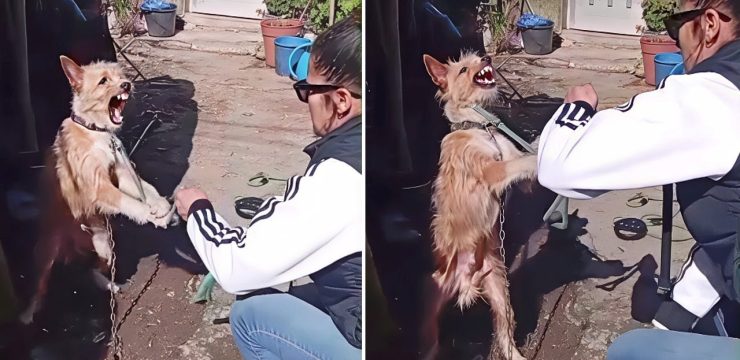
Ivy’s story begins in a quiet corner of a neighborhood where most people had long since stopped looking closely. It was early summer when someone finally noticed her, not because she made noise, but because of how little of her seemed to be left. A thin figure, barely more than bones beneath fragile skin, she had been surviving on a short chain, drifting between endurance and exhaustion. At times, she would wander into the yard of an elderly woman nearby, as if instinctively searching for a place that felt even slightly safer.
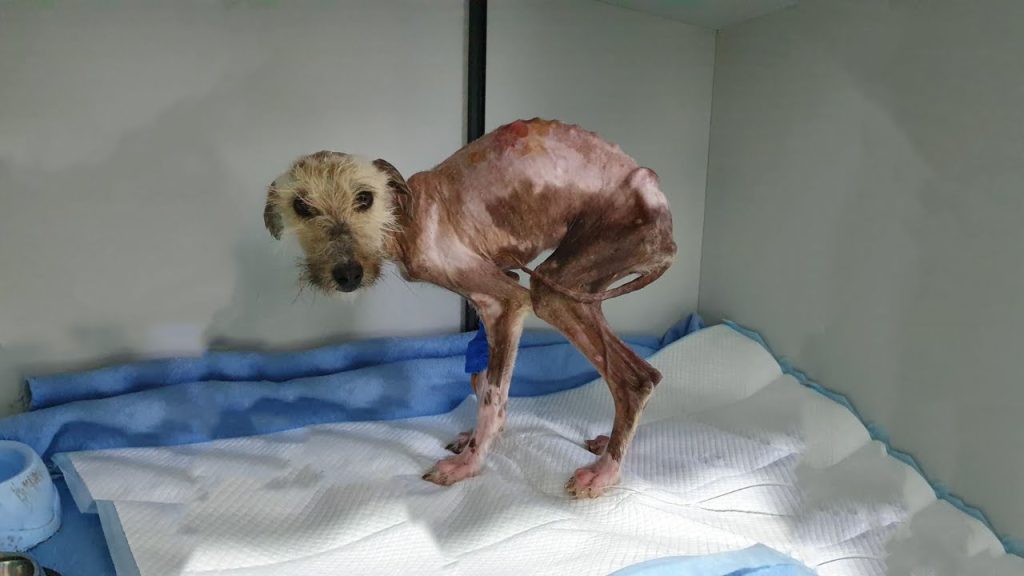
When rescuers arrived, they were prepared for hardship. But nothing quite prepared them for Ivy. She stood before them in a condition that was difficult to comprehend, even for those who had seen many difficult cases before. Her body was severely underweight, her frame so fragile it seemed almost impossible that she was still standing. Her skin showed clear signs of untreated conditions, and every movement she made reflected how much strength she had already lost. Yet despite everything, there was something still present in her eyes—a quiet awareness, a flicker of life that had not been extinguished.
The rescue team moved carefully, understanding that Ivy’s survival depended not just on urgency, but on gentleness. Every action was deliberate. Every touch was measured. They knew that recovery would not be immediate, and that even small steps forward would require patience. Ivy was transported to receive care, beginning a process that would demand time, resources, and unwavering commitment.
Support came from people who had never met her but felt compelled to help. Among them was a dedicated sponsor named Gaynor Pond, whose generosity became a cornerstone of Ivy’s recovery. Contributions like these made it possible for Ivy to receive thorough veterinary attention and a carefully structured nutrition plan designed to rebuild her strength slowly and safely.
In those early days of care, progress was fragile. Ivy was introduced to simple, nourishing meals—gentle portions of chicken prepared to support her weakened body. Each meal was a step forward, not just physically, but emotionally as well. Gradually, her body began to respond. The smallest signs of improvement—standing a little steadier, moving with slightly more confidence—became meaningful milestones.
At the same time, her skin conditions were treated with care and consistency. Healing was not immediate, but over time, the visible signs of neglect began to fade. As her physical health improved, so did her spirit. The quiet presence in her eyes slowly transformed into something brighter, something more engaged with the world around her.
Recovery is rarely a straight line, and Ivy’s journey was no exception. There were moments of uncertainty, days when progress seemed slow. But with each passing week, the change became more undeniable. Her body began to regain its natural form. Where there had once been only sharp outlines, there was now softness returning. Strength replaced fragility. Stability replaced hesitation.
Perhaps the most remarkable transformation was not just in Ivy’s appearance, but in her demeanor. The same dog who had once struggled simply to exist began to show signs of joy. Small, tentative expressions of curiosity grew into genuine engagement. She responded to voices, to touch, to the presence of those caring for her. Life was no longer something she was merely enduring—it was something she was beginning to experience again.
Over time, Ivy’s weight increased steadily, eventually more than doubling from where she had started. This physical change was a clear reflection of everything that had gone into her recovery: careful planning, compassionate care, and the quiet determination that defined every step of her journey.
As her transformation continued, attention turned toward the future. Ivy was no longer just a dog in recovery—she was ready for a home. A place where her past would not define her, but where her resilience would be understood and appreciated.
That future arrived in the form of Matilda Pacey, an adopter ready to offer Ivy exactly what she needed: stability, safety, and genuine care. The transition marked a profound milestone. After everything she had endured, Ivy was no longer alone, no longer uncertain of where she belonged.
The moment she stepped onto the transport that would carry her to her new life was both simple and deeply meaningful. It was not marked by noise or spectacle, but by quiet significance. A journey that had begun in hardship was now leading her toward something entirely different.
Ivy’s story is not just about recovery. It is about what can happen when compassion meets persistence. It is about the impact of people who choose to care, even when the outcome is uncertain. And most importantly, it is about the resilience that can exist even in the most difficult circumstances.
Today, Ivy is no longer defined by the condition in which she was found. She is defined by the life she now lives—healthy, secure, and surrounded by care. Her journey serves as a reminder that even in the most challenging situations, change is possible when there is patience, support, and a willingness to act.
For those who hear her story, Ivy represents something deeply human: the belief that no life is beyond hope, and that sometimes, the smallest act of kindness can become the beginning of everything.