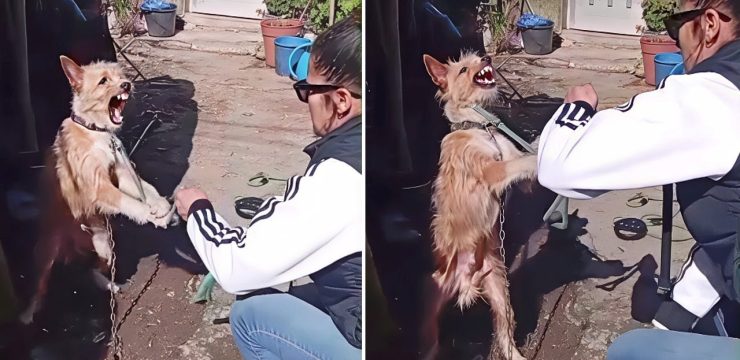
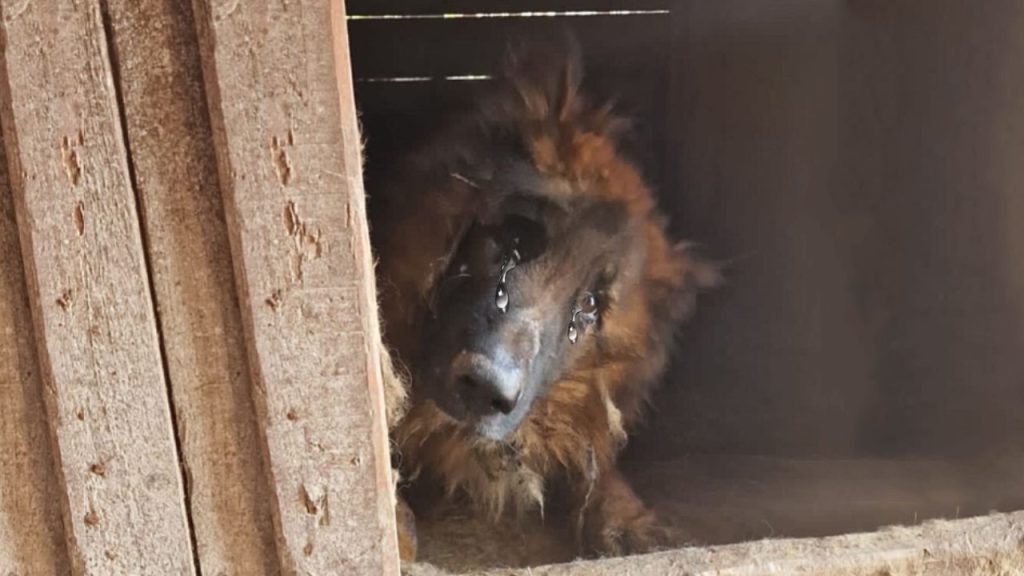
For most of his early life, Wawelek knew nothing but restraint. A heavy chain defined the boundaries of his world, limiting not only his movement but also his chance to trust, to explore, and to feel safe. From a very young age, he lived in isolation, cut off from the simplest joys that every dog deserves. By the time rescuers from an animal welfare organization finally reached him, his body carried the visible marks of neglect, and his spirit had been shaped by years of quiet endurance.
What makes his story remarkable is not just where he began, but how he slowly learned to begin again.
When Wawelek first arrived in the care of his rescuers, his condition was fragile. His body was weak, his coat thin and damaged, and his immune system compromised after such a long period without proper care. He was dangerously underweight, with ribs that stood out sharply beneath his skin. There was a sense that time had almost run out for him. Yet even in that difficult moment, there was something in his eyes—something soft, something willing—that suggested he had not given up completely.
Recovery did not happen overnight. It came in small, steady steps, guided by patience and compassion. Nutritious meals were introduced carefully, helping his body regain strength without overwhelming his system. Medications were administered to support his healing, and specialized baths were given to treat the skin conditions that had developed during his years of neglect. Each bath was more than a medical necessity; it was an act of care, a gentle reassurance that his suffering had been seen and would not be ignored.
As the days passed, subtle changes began to appear. His posture improved. His movements became more confident. And perhaps most importantly, his emotional world began to open. For the first time, Wawelek experienced what it meant to feel safe. There were no chains, no harsh limitations—only space, kindness, and the quiet presence of people who expected nothing from him except that he heal.
One of the most touching moments in his journey came when he began to greet his caregivers with gentle tail wags. It may seem like a small gesture, but for a dog who had spent so long in confinement, it marked a profound emotional breakthrough. His eyes, once guarded and uncertain, now carried a glimmer of trust. He was not just surviving anymore; he was beginning to connect.
As his strength returned, Wawelek reached an important milestone in his physical recovery. He was healthy enough to undergo a necessary surgical procedure, one that would contribute to his long-term well-being. The success of this step was a testament to how far he had come. It reflected not only the dedication of his caregivers but also his own quiet resilience.
Despite his large size, which can sometimes make introductions more challenging, Wawelek revealed a gentle and balanced temperament when meeting other dogs. Instead of tension or fear, he approached them with calm curiosity. In a shared environment with other rescue animals, he adapted beautifully, showing that his difficult past had not taken away his ability to coexist peacefully. Watching him interact with the other dogs became another powerful sign that healing is not only physical but deeply social and emotional as well.
Among his companions was another dog named Yeti, who had also been rescued in a severely weakened state. Like Wawelek, Yeti had once struggled just to survive. Now, the two dogs stood as quiet reminders of what consistent care and compassion can achieve. Their presence together added a layer of shared understanding, as if each recognized something familiar in the other’s journey.
One of the most visible transformations in Wawelek’s story was his weight gain. With proper nutrition and ongoing care, he gained a significant amount of weight, gradually filling out his once fragile frame. The sharp outlines of his ribs disappeared, replaced by a healthier, stronger body. This physical change symbolized more than improved health; it represented stability, nourishment, and the restoration of dignity.
His coat, though still in the process of fully recovering, began to show signs of improvement as well. Where there had once been patchiness and irritation, there was now gradual regrowth and healing. It was a slow process, but one that mirrored the deeper restoration happening within him.
Wawelek’s journey is a powerful reminder that recovery is rarely immediate or dramatic. It is often quiet, unfolding day by day through consistent care and trust. His story does not rely on sudden miracles but on the steady presence of people who chose to invest time, patience, and compassion into a life that had been overlooked for far too long.
Today, he stands not as a symbol of suffering, but as a living example of resilience. The dog who once knew only chains now understands freedom. The dog who once lived in isolation now experiences connection. And the dog who once hovered on the edge of survival now moves forward with strength and calm confidence.
There is something deeply meaningful in witnessing a life change in this way. It reminds us that even in the most difficult circumstances, healing is possible when care is consistent and genuine. Wawelek’s story does not erase his past, but it shows that the future can be shaped by kindness, one careful step at a time.
For those who follow his journey, the impact is lasting. It encourages reflection, empathy, and a renewed appreciation for the quiet strength that animals carry. In the end, Wawelek did not just recover—he rediscovered what it means to live.