Nobody knows exactly how long he had been out there. But when a little boy spotted an elderly dog dragging himself up a hill, struggling with every movement, he knew something was terribly wrong. That small act of a child’s compassion — pausing, noticing, and calling for help — would change everything for a dog the world had already given up on.
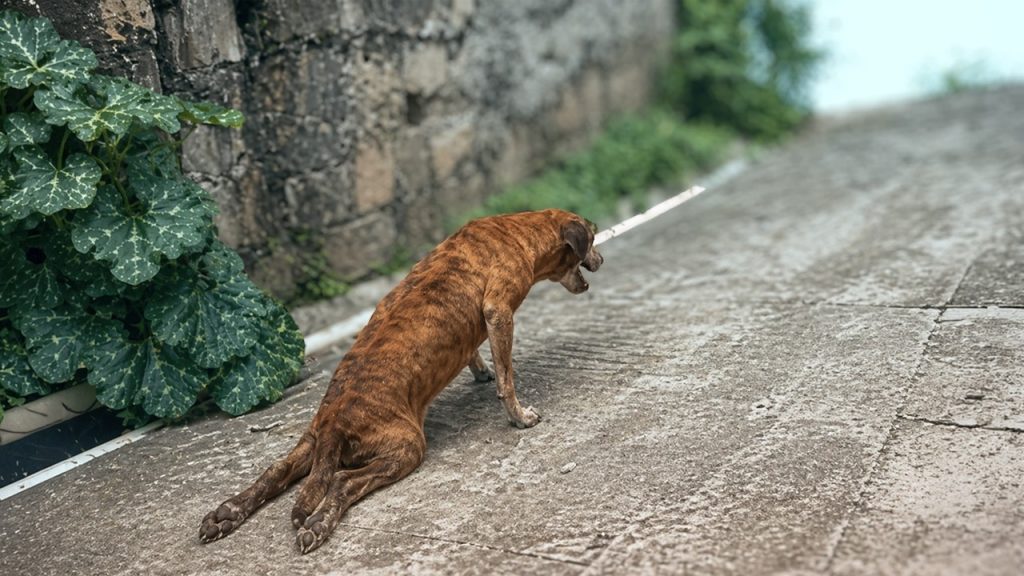
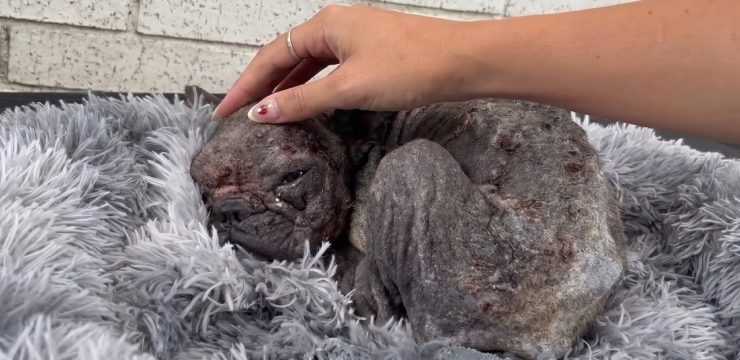
When rescuers arrived, they found a senior dog in heartbreaking condition. He was old, toothless, and completely paralyzed in his hind legs. His eyes darted with fear as strangers approached, every instinct in his frail body telling him that humans meant danger. He had likely learned that lesson the hard way. Still, the rescue team moved slowly and gently, speaking softly until the trembling subsided just enough for them to bring him to safety.
They named him Risas — a word that means laughter in Spanish. It was a deliberate, hopeful choice. If this dog’s future was going to be written by the people who now cared for him, they wanted it to be filled with joy.
At the veterinary clinic, the full weight of Risas’s condition became clear. Blood tests confirmed he was battling not one, not two, but three serious illnesses simultaneously: Ehrlichiosis, Anaplasmosis, and heartworm disease. Together, these infections had severely weakened his immune system, leaving his body fighting a war on multiple fronts. The team braced for the worst.
But there was a sliver of hope tucked inside the grim diagnosis. His spine had not been broken. Instead, two vertebrae had compressed tightly against one another, pinching the nerves responsible for movement in his hind legs. It was serious — but it was not hopeless. Because Risas still had some sensation in those legs, veterinarians believed that with the right care, he might walk again. The challenge was his age. Surgery carried far too much risk for a dog as elderly and medically fragile as he was. So the team chose a different path: patience, persistence, and physical therapy.
His treatment plan was rigorous. Corticosteroids were administered to reduce the inflammation pressing against his spinal nerves. Pain management kept him as comfortable as possible during a process that was, at times, deeply uncomfortable. Nerve-supporting injections were given regularly. And every single day, the team worked with him through careful, gentle physical therapy — moving his legs, encouraging circulation, coaxing his nervous system back to life.
In the beginning, Risas resisted. He was in pain, and he was afraid. A lifetime of experiences — whatever they had been — had taught him to be wary of human hands. But the rescue team did not give up. They showed up for him again and again, with soft voices and steady hands, until slowly, almost imperceptibly, something shifted. He began to trust them.
While his body was healing, the team also began asking questions about his past. It didn’t take long to discover that his former owner lived in the area nearby. The circumstances surrounding how Risas ended up paralyzed and alone on that hill remained unclear — a mystery that may never be fully solved. But the neglect was undeniable. Authorities were notified, and the case was formally reported.
What happened next is the part of this story that no one on the rescue team will ever forget.
After days of therapy, of whispered encouragement and unwavering dedication, Risas stood up on his hind legs.
It was not graceful. It was not easy. But it was real — and it was nothing short of a miracle. The rescuers who witnessed that moment wept openly. All the early mornings, all the long hours, all the times they had wondered whether they were doing enough — it all led to this. A dog who had been left for dead, standing on his own two feet.
And the transformation didn’t stop there. As Risas’s body grew stronger, something else changed too. The fear that had once lived behind his eyes began to fade. In its place grew something quieter and more profound — a warmth, a trust, a kind of peace that only comes to a creature who has finally learned that it is safe to rest. His gaze, once clouded with sorrow, began to carry a gentle light.
He is not fully recovered. His journey is still ongoing, and the road ahead requires continued care and commitment. But Risas is no longer alone on that road. The team that found him — the people who gave him a name that means laughter — walks beside him every step of the way.
There is something about a story like this that lingers long after you’ve heard it. Maybe it’s the image of a small boy stopping to notice a suffering animal when the rest of the world walked past. Maybe it’s the image of exhausted rescuers crying tears of relief the moment an old dog found his footing. Or maybe it’s simply the reminder that it is never too late to matter to someone — and that even the most forgotten soul can find its way back to joy.
Risas came into this world with no name and left one chapter of his life in pain and silence. But he is writing a new chapter now — and for the first time in a long time, it sounds like laughter.