There is one thing you need to understand about Belgian Malinois before anything else. They are not house pets.
They are bred for duty, built with an engine that never truly rests.
My K9 partner, Brutus, was eighty pounds of solid muscle, sharp instinct, and rock-solid obedience. We had worked side by side for four years. He lived in my home. He slept at the foot of my bed. On two separate deployments, he pulled me out of dark alleys where danger was waiting in the shadows.
But a working dog is still an animal.
Every handler carries one quiet fear in the back of his mind. It is the fear of the “snap,” the moment the training fails and raw instinct takes over.
I thought that moment had finally come on a cold Tuesday afternoon in November.
I was off duty, wearing jeans and a heavy jacket, walking Brutus through Centennial Park. The sky was a flat, overcast gray, and the biting wind kept the crowds thin. Still, the playground was full. Kids climbed the slide. Moms sipped coffee on the benches. Dads pushed toddlers on the swings.
Brutus knew he was off the clock. His stride was loose and his ears were relaxed. He was simply a dog enjoying the smell of damp pine needles and falling leaves. The heavy leather leash was looped securely around my right wrist.
We followed the paved path that curved along the playground. On our left sat the sandbox and the slide. On our right was a steep bank covered in dead leaves, thick ivy, and an old, crumbling stone wall.
Then, without warning, the leash went tight with a jolt that nearly pulled my shoulder out of place.
I turned around.
Brutus had frozen like a statue cast in iron. The fur along his back stood up from his neck to the base of his tail. His ears were pinned flat. His eyes were locked on something near the edge of the playground.
I followed his gaze.
A little girl, maybe six years old, stood near that stone wall. She wore a bright pink puffy jacket and a white knit beanie. She had wandered away from the other children and was kicking at the leaves, all alone.
Her mother was about thirty yards away, holding a paper coffee cup, her eyes on her phone.
“Brutus, heel,” I said sharply.
He didn’t move.
That scared me more than anything. Brutus never ignored a command. Never.
“Brutus. Heel.”
A deep rumble rose from his chest. I had heard that sound only once before, the day an armed suspect cornered us in a basement.
The little girl bent down, her mittened hand reaching for a colorful leaf resting on a rock.
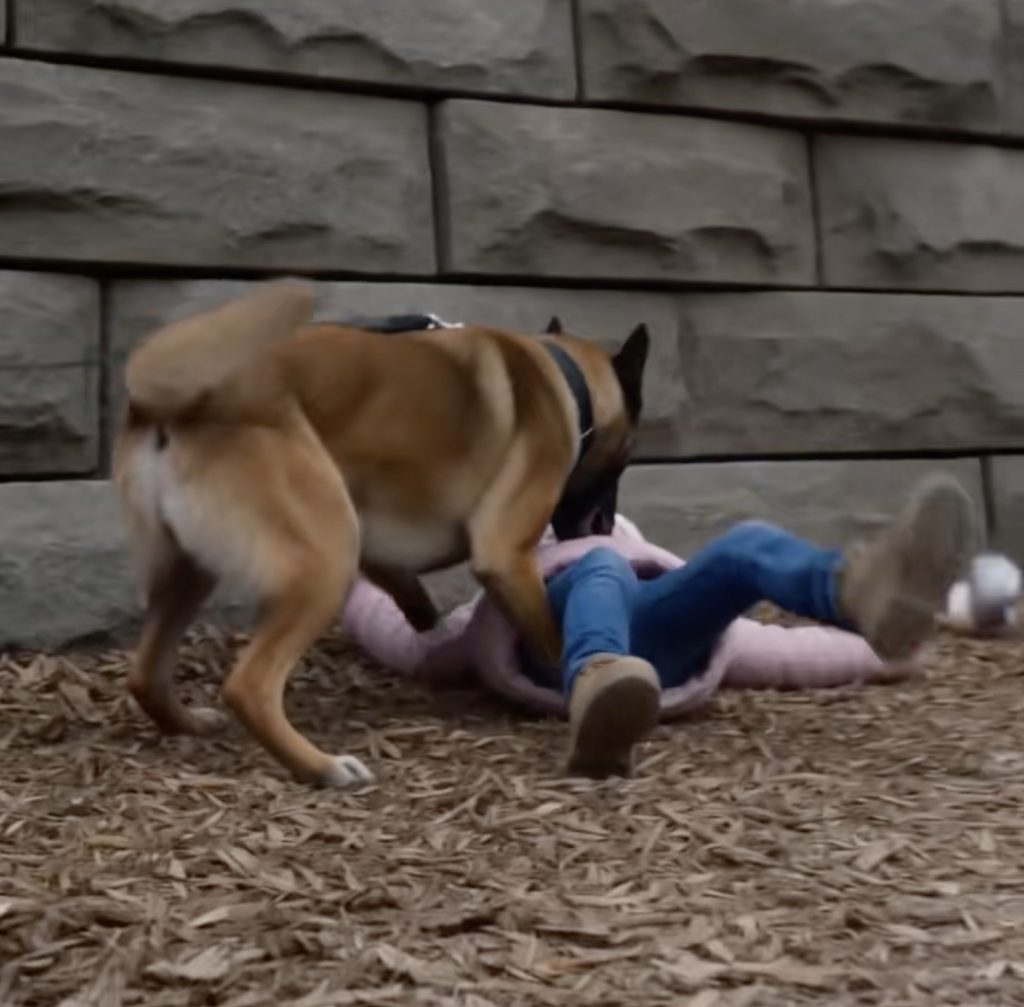
And Brutus launched.
He hit the end of the leash so hard that the brass ring on his harness broke clean off. I fell to my knees, gripping nothing but a broken strap.
“Brutus, NO! PLATZ!”
He didn’t listen.
He was a streak of tan and black, closing the distance in a heartbeat. I saw the little girl turn, her blue eyes wide with fear. Brutus struck her square in the chest, and she tumbled backward onto the cold ground. He landed right over her.
The whole park erupted in screams.
The mother dropped her coffee. “MY BABY!” she cried. “HE’S HURTING MY BABY!”
I ran harder than I have ever run in my life, every rule and every consequence racing through my mind.
What none of us could see was what Brutus had already sensed by that old wall.
Hidden in those leaves were venomous vipers. And beneath that very ground, something far worse was waiting. Brutus fought off the snakes with his own body, and moments later a gas explosion tore through the earth, leaving a burning crater right where that little girl had been standing.
When the dust settled, a man in a flannel shirt looked Brutus straight in the eyes.
“This animal just performed a miracle,” he said.
I swallowed hard. “I know,” I whispered.
“Excuse me.”
The voice behind me was small and shaking.
I turned. Standing behind the yellow police tape was the mother. The same woman who had called my dog a monster. The same woman who had begged a stranger to shoot him.
She was holding her daughter tight against her chest. The little girl’s pink jacket was covered in dirt and woodchips, but she wasn’t crying anymore. She was sucking her thumb, staring at the big fire trucks with wide, wondering eyes.
When the mother saw Brutus coming toward her, she didn’t flinch. She sank to her knees right there on the wet pavement, eye to eye with my dog, sobbing.
“I didn’t know,” she cried. “I thought he was hurting her. I told them to shoot him.”
She looked back at the flames in the crater. “She was standing right there,” she whispered. “Right on top of it.”
I knelt beside her. “It’s okay,” I said gently. “You were protecting your child. Any mother would have done the same.”
She slowly reached out a trembling hand.
I didn’t stop her. I knew my dog.
Brutus stepped forward, lowered his big head, and pressed his nose softly into her palm. He let out a gentle whine.
She wrapped her arms around his neck and wept into his fur. Brutus simply leaned his weight against her and let her cry.
Then the little girl toddled over, reached out her tiny mittened hand, and patted him on the head.
“Good puppy,” she whispered.
Across the lot, the man in the flannel shirt caught my eye. He didn’t wave. He just placed his hand over his heart and gave me a slow, solemn nod.
I nodded back.
That night, I finally brought Brutus home. I took off his collar and harness and checked every inch of him. Not a scratch. Not a single burn.
He drank half a bowl of water, walked into my bedroom, climbed onto the foot of the bed, circled twice, and lay down with a long, tired sigh.
I stood in the doorway, watching him sleep in the glow of the streetlight.
Belgian Malinois are bred for hard work. They are built to run toward the very things that make the rest of us run away.
But as I watched his ribs rise and fall in the quiet dark, I realized the fear of the “snap” is a story we tell ourselves because we don’t fully understand them.
When the training falls away and the world is burning beneath their feet, they don’t become monsters.
They become guardians.
Brutus didn’t just save a little girl that day. He saved me, too. He showed me that the heart of a working dog is one of the purest, most selfless things on this earth.
I sat on the edge of the bed and rested my hand on his back. He didn’t wake, but his tail gave one slow thump against the blanket.
“Good boy,” I whispered.
“Good boy.”