Not the wife. Not the man sitting stiffly on the couch. Not even the soldier standing in the middle of the room, still holding his daughter’s small stuffed rabbit in one hand and a crumpled drawing in the other. None of them moved. None of them spoke. The only thing that seemed alive in that moment was the silence itself—slow, heavy, and suffocating, pressing down on every breath and every thought like an invisible weight.
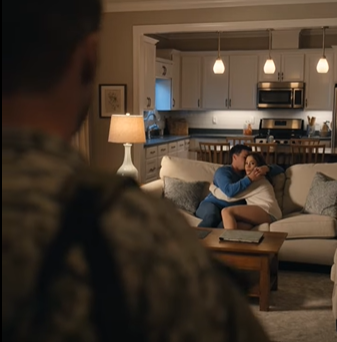
It lingered, stretching longer than it should have, filling every corner of the house with something cold and unspoken. It was the kind of silence that didn’t just surround a moment—it defined it.
Then, from upstairs, a small voice broke through.
Soft. Sleepy. Fragile.
“Mommy?”
The soldier’s head turned toward the staircase immediately, instinct sharper than reason. His entire body shifted, as if pulled by something deeper than thought. Before he could take a step, his wife reached out and grabbed his arm, her fingers tightening around his sleeve.
“Please,” she whispered, her voice trembling. “Don’t go up there like this.”
He looked down at her hand. Then slowly, he lifted his eyes to meet her face. Whatever she saw in his expression made her release him instantly, as if she had touched something she no longer understood.
Because in that moment, this wasn’t only about broken trust anymore. It wasn’t just about what he had walked in on, or the truth that had been sitting in front of him, undeniable and raw.
Now, it was about something far deeper.
It was about the child upstairs—his child—learning how to live inside a lie.
Without another word, he turned and walked toward the stairs. Each step he took was steady, deliberate. His boots hit the wood with a dull, echoing sound, like quiet judgment marking every second. The house seemed to hold its breath with him.
At the top of the stairs, the hallway light cast a soft glow over a small figure standing there.
Emma.
She was wrapped in her pajamas, her blanket clutched tightly to her chest. Her hair was slightly messy from sleep, her eyes still heavy, trying to make sense of the world she had just woken into.
When she saw him, her expression changed instantly.
“Daddy?”
The word landed harder than anything else that night.
For a moment, it nearly broke him.
He dropped to his knees in front of her, opening his arms without hesitation. Emma ran into them immediately, as if she had been waiting for that exact moment. He wrapped his arms around her tightly, holding her with a kind of desperation he couldn’t hide. She let out a small squeak from the pressure, but she didn’t pull away. Instead, she held onto him just as tightly, her small hands gripping his shirt as if she needed to be sure he was real.
After a moment, he eased back just enough to look at her face.
His voice, when he spoke, was soft—careful.
“Baby,” he asked gently, “who is the soldier man?”
Emma’s gaze dropped instantly. Her small fingers tightened around the edge of her blanket. Then, slowly, she glanced past him, toward the staircase where her mother stood halfway up, frozen in place.
Her voice, when it came, was barely above a whisper.
“You.”
The soldier swallowed hard, his throat tightening.
“Then why,” he asked quietly, “did you say it like that?”
Emma’s eyes filled with tears, the kind that come when a child knows they are standing on the edge of something they don’t fully understand but can still feel. Children always sense more than adults realize—especially when they are asked to carry things they were never meant to hold.
She hesitated, her lips trembling.
Because she knew.
She knew she wasn’t supposed to say it.
She knew there was a “right” answer, and a “safe” answer, and that they were not the same.
Finally, in a voice that shook with uncertainty, she whispered the truth.
“Because Mommy said I should call you that when he’s here… so I don’t mix you up.”
The air in the hallway seemed to collapse inward.
Downstairs, the man on the couch didn’t move. He didn’t speak. He didn’t even try to come up. Whatever courage he had once believed he possessed had vanished completely, leaving behind only silence and stillness.
The soldier closed his eyes.
Just for a second.
One brief moment to steady something inside himself that threatened to unravel.
When he opened them again, the pain was still there. The hurt hadn’t disappeared. But it had changed. It had hardened, becoming something colder, something quieter, something far more controlled.
He stood, lifting Emma into his arms as if she weighed nothing at all. She rested her head against his shoulder, her small body instinctively seeking comfort in the one place she still felt safe.
He carried her downstairs.
Each step felt heavier than the last, but he didn’t slow down.
At the bottom, his wife was already crying openly, her composure completely gone.
“It’s not what it sounds like—” she began, her words rushing out in panic.
But the sentence didn’t survive.
It couldn’t.
Because the moment he looked at her, both of them understood the truth.
It was exactly what it sounded like.
Nothing more. Nothing less.
The man near the couch stood frozen, his face pale, his posture rigid, as if he were trying to disappear without actually moving.
The soldier adjusted his hold on Emma slightly, keeping her close, protective without effort. Then, with his free hand, he reached down and picked up his duffel bag from the floor.
When he finally spoke, his voice was quiet.
And that made it worse.
“You didn’t just betray me.”
The words hung in the air for a moment before he continued.
“You made our daughter live inside the lie.”
His wife covered her mouth, her sobs breaking through completely now. There was nothing left to say that could undo what had already been done.
Emma pressed her face into his shoulder, sensing the shift in the room. She didn’t understand everything, not yet. But she understood enough to feel afraid.
And that was enough.
The soldier turned his gaze toward the other man, his expression steady, unreadable.
“Be gone before I come back for the rest of her things.”
There was no anger in his tone. No shouting. No threats.
Just certainty.
No one argued.
No one tried to defend themselves.
Because in that room, at that moment, everyone understood what had truly happened.
The loudest thing there wasn’t rage.
It wasn’t accusation.
It wasn’t even the sound of someone crying.
It was something far quieter.
The unmistakable, irreversible sound of a family breaking—without a single raised voice, without a single slammed door.
Just silence.
And the weight of everything that would never be the same again.