Captain Dubois stood outside cell 312, weighed down by a kind of curiosity he wasn’t used to feeling. The sharp scent of disinfectant lingered in the corridor, mixed with a faint trace of dampness that clung to places where sunlight rarely reached. Inside the cell, Rémy Laurent sat on the edge of his narrow bed, his shoulders trembling with quiet sobs. His face was hollow from exhaustion, streaked with tears, his eyes fixed on the empty space where a small, barred window let in a pale strip of gray light.
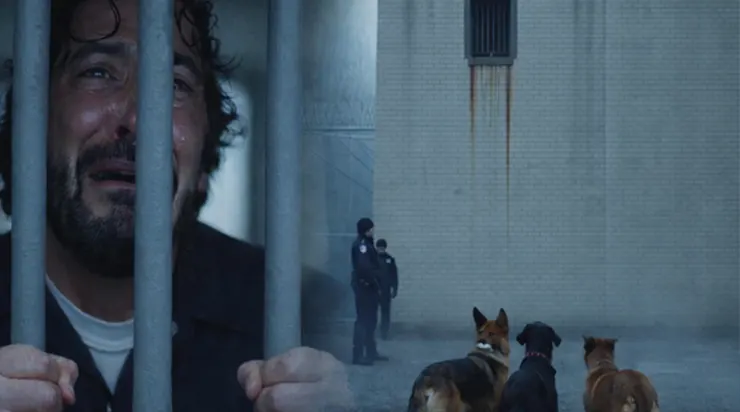
“Laurent,” Dubois began, his voice less commanding than usual, touched with hesitation. “Explain this to me. What do those… animals have to do with you? And what you said earlier—about your father?”
Rémy slowly lifted his red, swollen eyes. His throat seemed tight, as though every word had to fight its way out. “They’re his… ours,” he whispered, his voice barely audible. “They never forgot me.”
Dubois stepped inside, leaving the cell door open behind him. “Speak up, Laurent. What’s going on with your father? And why are those animals out there, barking beneath your window?”
Rémy drew in a shaky breath, as if the air itself burned his lungs. “My father… he’s old. Very old. He has no one left. Just them. And me.” His words came in fragments, each syllable heavy with effort. “He’s bedridden. Weak. I’m here… and there’s no one to take care of him.”
A chill ran down Dubois’s spine. The image of an elderly man alone, helpless, lodged itself firmly in his mind. He pulled over a small steel stool and sat down. “No one? No home care, no neighbors checking in?”
Rémy shook his head. A single tear slipped down his cheek. “He’s always kept to himself. A proud man. And after what happened to me… the shame…” His voice broke, dissolving into a muffled sob. “Those three,” he added, nodding toward the window, “they’re his only companions. They stayed with him. Loyal. They never left.”
“And you think they sensed something?” Dubois asked carefully. “That they came all the way here for you?”
“They’re smart,” Rémy murmured, a flicker of pride cutting through his grief. “They love him. And they love me. They must have known something was wrong. That there was no one left to care for him.” He suddenly stood, his eyes pleading. “Captain, I need to know if he’s okay. If he’s eaten. If he’s safe.”
Dubois rose as well, a decision forming in his mind. “Laurent, I can’t promise much…” He paused, studying the desperation in the man’s face. It was real, undeniable. And the scene outside—the relentless barking, the animals’ restless presence—had stirred something in him. “But I’ll see what I can do.”
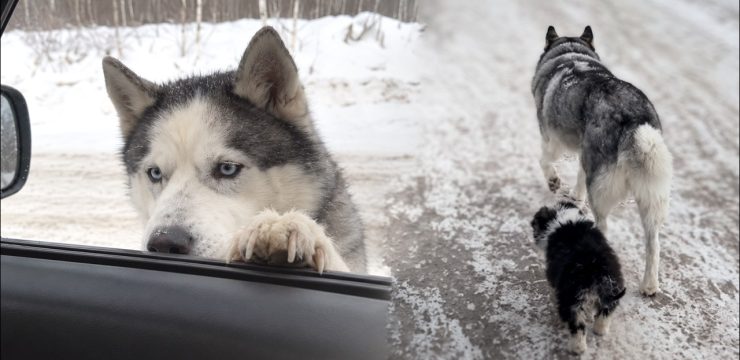
A few hours later, the prison yard became the setting for something no one had expected. After lengthy discussions with the administration, Captain Dubois made a bold decision. Rémy Laurent, his hands restrained, was escorted to a small grassy area enclosed by high walls. The three dogs stood nearby, held on leashes by a guard who looked visibly uncertain. They had calmed somewhat, but their eyes remained fixed on the gate.
The moment Rémy appeared, a sharp whine broke from one of them, quickly joined by the others. They pulled hard against their leashes, their bodies trembling with excitement, their tails beating wildly against the ground. Rémy’s knees nearly gave out beneath him.
“Easy,” the guard muttered, struggling to keep control.
“Let them go,” Dubois said, his voice unexpectedly gentle.
The guard hesitated, then released the leashes.
The three dogs surged forward in a blur of motion and emotion. They leapt onto Rémy, nearly knocking him off balance, their noses pressing into his hands, their bodies leaning against him with desperate affection. They licked away his tears, their soft cries of joy blending with his own sobs—no longer born of despair, but of overwhelming relief.
“My friends… my friends,” Rémy whispered, holding them close, burying his face in their fur, feeling their warmth and unwavering love. “You came… you really came.”
Dubois watched silently, a wave of emotion rising unexpectedly within him. This was more than a simple reunion between a man and his pets. It was something deeper—a living testament to loyalty and connection. He had already ordered a check on Rémy’s father. The report had come back: the man was indeed bedridden, alone, with no one to care for him. The dogs’ actions were no coincidence.
“We’re going to take care of your father, Laurent,” Dubois said as he stepped closer, his voice steady but filled with newfound compassion. “Social services will step in. He won’t be alone anymore.”
Rémy looked up, his eyes shining with gratitude. “Thank you, Captain. Thank you.”
In the months that followed, change slowly took hold. The regular visits from the dogs became something of a quiet legend within the prison walls—a story passed from inmate to inmate, a reminder that loyalty still existed in the world beyond those bars. Rémy, strengthened by the knowledge that his father was being cared for, found new purpose. He worked tirelessly, his behavior exemplary, a renewed light in his eyes.
Then one morning, Captain Dubois entered his cell again, a file in hand.
“Laurent,” he began, a rare smile softening his usually stern expression. “There’s been a review of your case. Your conduct, the circumstances… and your father’s situation.” He extended a document toward him. “The governor has granted you clemency.”
Rémy’s hands trembled as he took the paper. One word stood out above all the others: Release. He stared at it, hardly able to believe what he was seeing. A second chance.
“You’re going home,” Dubois said quietly. “Your father needs you.”
A few days later, Rémy walked through the prison gates a free man. The fresh air and sunlight felt unfamiliar against his skin, like something from another life. The three dogs were waiting for him nearby, tied to a post, their bodies vibrating with anticipation. The moment they saw him, they erupted into joyful barking, a chorus of happiness echoing through the stillness.
Rémy dropped to his knees, embracing them one by one, feeling their warm tongues against his hands, their bodies pressed tightly against him. “I’m here,” he whispered. “I’m home.”
The journey back carried a quiet, hopeful tension. When the small house of his childhood came into view, the garden slightly overgrown but still familiar, his heart began to race. He stepped inside, the dogs trotting eagerly at his side.
His father lay on the couch, frail but alert, a blanket draped across his legs. When he saw Rémy, his eyes filled with tears.
“My son…” he breathed.
Rémy knelt beside him, gently taking his thin, fragile hand. “I’m here, Dad. I’m back.”
The dogs gathered around them, whining softly, their noses moving between the old man’s hands and Rémy’s, as if making sure they were truly reunited. They had brought their family back together, reconnecting the two people who meant everything to them.
The setting sun poured golden light into the room, illuminating faces marked by time, hardship, and love. The soft sounds of the dogs, the quiet sobs of relief, and the warmth of reunion blended into something deeply human and profoundly comforting. Rémy was no longer just a former prisoner. He was a son, a caretaker, and a man given a second chance by the quiet, unwavering loyalty of three devoted souls. Life, fragile and precious, had found its way forward again—carried by love, restored by compassion, and anchored by the simple, powerful truth that loyalty can open doors even when all hope seems lost.