Lucky’s story begins in a place no living creature should ever endure—inside a crumbling, abandoned house that neighbors described as a nightmare. For days, faint and desperate barking echoed through broken windows and hollow rooms. The sound was so weak it could have been mistaken for the wind. But someone listened closely enough to realize it was a cry for help.
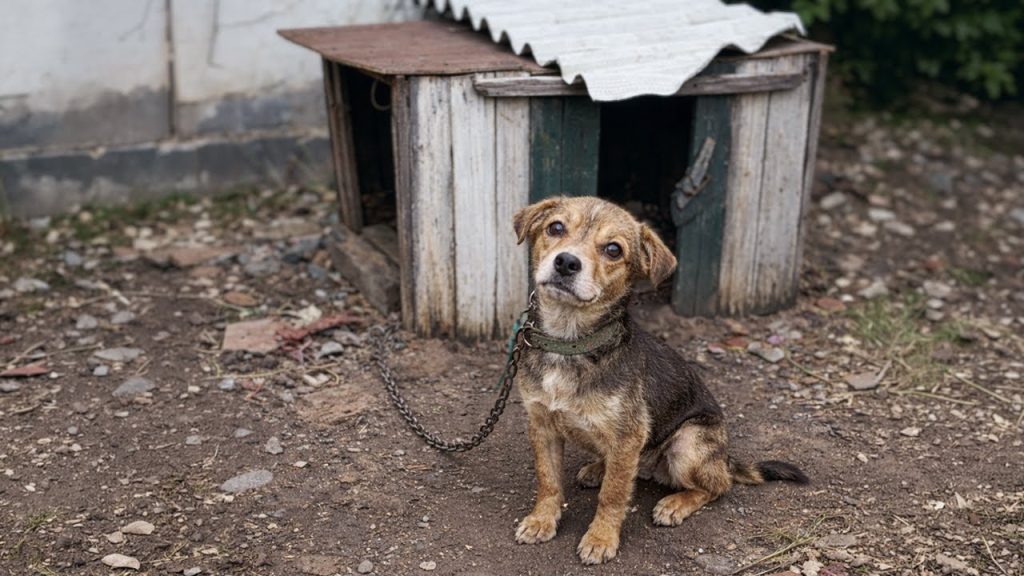
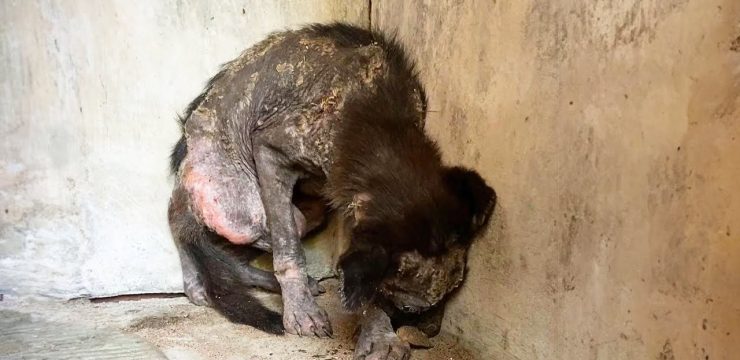
When rescuers finally stepped inside, they found Lucky chained in the shadows. She was painfully thin, little more than skin and bones, her fragile body trembling with fear. Her eyes told a story long before any examination did. They were wide, exhausted, and haunted by something deeper than hunger. She did not growl or lunge. She barely moved. Trauma had quieted her spirit.
Carefully, the rescuers approached and freed her from the heavy chain that had confined her for so long. Even that simple act seemed to overwhelm her. Freedom, something she should have known since puppyhood, felt unfamiliar. Every movement revealed weakness. Every step showed how much she had endured in silence.
At the veterinary clinic, the full extent of her suffering became clear. Lucky was dehydrated and malnourished. Bruises marked her frail body. Most alarming of all, she had a fractured hip that had likely gone untreated for some time. The pain she must have lived with daily was difficult to imagine. Yet through it all, she had survived.
Recovery was not immediate. Healing never is, especially when the wounds are both physical and emotional. Lucky needed medical treatment, nourishment, and time. But she also needed something far more delicate—trust. Years of confinement had taught her that the world was small and unkind. Learning otherwise would require patience from everyone around her.
That patience came in the form of gentle caregivers and, unexpectedly, a new companion. In her foster home, Lucky met Nord, a calm and confident dog who seemed to understand her fear without judgment. Nord did not crowd her or demand attention. He simply existed nearby, offering a quiet example of what safety looked like.
Watching Nord interact comfortably with people became part of Lucky’s healing. She observed how he responded to soft voices and kind hands. She noticed that food arrived regularly and that no chain followed. Slowly, almost imperceptibly at first, she began to mirror his behavior. She stepped forward instead of shrinking back. She lifted her head. She wagged her tail, timidly at first, then with growing assurance.
As her hip was treated and her body strengthened with proper nutrition, her transformation accelerated. The bones that once pressed sharply beneath her skin began to soften under healthy weight. Her coat regained a gentle shine. The bruises faded. But the most remarkable change was in her eyes. The hollow stare gave way to curiosity. The fear began to loosen its grip.
Training sessions introduced her to basic commands—simple requests like sit and stay. To an outsider, these might seem small accomplishments. But for Lucky, each command mastered represented a victory over her past. Each success confirmed that cooperation could bring praise rather than punishment. Her confidence expanded one day at a time.
Meanwhile, authorities continued to investigate how she had ended up chained in that abandoned house. A breakthrough came through an unexpected source: a local homeless man who recognized her and provided information that led officials to her former owner. Confronted with the evidence, the man admitted that Lucky had been kept chained since she was a puppy. His intention, he confessed, was to use her for breeding when she was older. He offered no explanation for her injured hip, leaving unanswered questions about how such harm occurred.
While the legal process moved forward, Lucky’s life kept moving in a different direction. The past no longer defined her daily existence. Instead, her world filled with routines that built stability—morning walks, mealtime rituals, quiet evenings resting beside Nord. She began to seek affection, pressing gently into the hands of those she had once avoided.
There is something profoundly moving about watching a living being rediscover joy after hardship. Lucky did not simply gain weight or recover from injury; she reclaimed her identity as a dog meant to run, explore, and belong. The timid creature who once trembled in a darkened house became vibrant and expressive. Her tail wagged freely. Her body moved without hesitation. Her spirit, once diminished, rose again.
For many who have followed her journey, Lucky’s story serves as a reminder that resilience often lives quietly beneath suffering. It also highlights the power of intervention—the importance of neighbors who listen, rescuers who act, and caregivers who refuse to give up on a frightened animal. Without that chain of compassion, her story might have ended very differently.
Today, Lucky is unrecognizable from the dog who was first discovered. She greets the world with bright eyes and an eager step. She plays beside Nord, no longer watching from a distance but joining fully in life. The house that once imprisoned her is only a memory. In its place stands a future defined by safety, dignity, and love.
Her name could not be more fitting. Lucky survived circumstances that could have broken her completely. Lucky found people who cared. And most of all, Lucky now experiences the simple freedoms every dog deserves—the freedom to move, to trust, and to be cherished without condition.