His name was Marcos. He wasn’t a professional driver, and he certainly wasn’t an animal rescuer. He was just an ordinary man who had stepped out of his home that morning to buy paint. He had promised himself he would repaint his balcony railing that summer. There were still faint smudges of dried paint on his hands, leftovers from an attempt he had made a few days earlier before deciding to put it off.
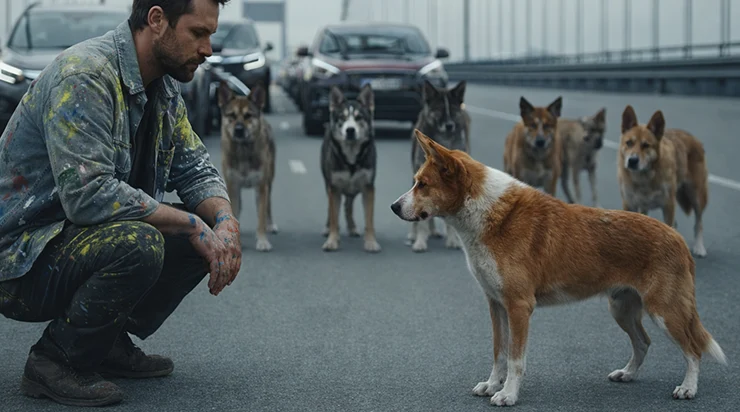
Standing there now, on a crowded bridge facing twenty distressed dogs, that detail felt strangely irrelevant—almost absurd. Paint on his fingers, while life had suddenly placed him in front of something far more urgent.
When Marcos said he was going to walk toward the dogs, a woman beside him reached out and grabbed his arm. She didn’t say a word. She just looked at him, deeply and steadily. In her eyes, there was a silent message: “Be careful,” but also, “You’re not alone.” Marcos gave a small nod and slowly began to move forward.
He kept his hands empty, palms open, his steps slow and deliberate. He didn’t know if this was the right approach, but something inside him told him he needed to show that he meant no harm. With every step, he could feel the weight of the crowd behind him—silent, tense, watching.
No one moved. Even the wind seemed to hold its breath.
The lead dog, standing slightly ahead of the others, remained perfectly still. Its body was tense, ears alert, but its tail wasn’t tucked. It didn’t run, and it didn’t growl. Instead, it looked straight into Marcos’s eyes with an intensity that felt almost human, as if it were trying to understand him—measure him.
Marcos stopped about three steps away. He didn’t go any closer. Instead, he slowly bent his knees and lowered himself to the dog’s level, making sure his gaze didn’t tower over it.
That small gesture changed everything.
The dog’s ears softened slightly, and its breathing, which had been quick and uneven, began to steady.
“I’m listening,” Marcos whispered gently, unsure if the dog could understand his words, but speaking anyway—as one might speak to a frightened child. “I don’t know what happened, but I’m here. We’re all here.”
The dog’s tail gave a slight movement—not joyful, but cautious, like the first crack in a wall of tension. Behind it, the other dogs began to shift, one by one. Some sat down. Others tilted their heads. Their whimpers became shorter, less frantic, as if something inside them dared to hope.
Footsteps sounded behind Marcos. He didn’t turn, but he could sense that others had come closer, forming a quiet, protective circle several steps behind him. No one spoke, but their presence mattered.
Then the lead dog took a step forward.
And another.
It moved carefully until it was close enough to reach Marcos’s hand. Marcos didn’t move. He held his position, his eyes steady.
The dog paused for a moment, then slowly lowered its head and placed it into Marcos’s open palm.
Time seemed to stop.
There were dozens of people on that bridge, but in that moment, it felt like no one breathed. The dog’s fur was dusty, its ribs faintly visible, its eyes carrying both exhaustion and something deeper—a fragile trust that appears when there’s nothing left to lose.
Marcos felt his vision blur slightly. The warmth and weight of the dog’s head in his hand said more than words ever could.
“It’s okay,” he murmured softly. “We’re together now.”
With slow, gentle movements, he began to stroke the back of the dog’s head. The dog didn’t pull away. Instead, it leaned into his touch, and something inside its body seemed to release—a tension it had been holding for far too long.
One by one, the other dogs began to approach.
Not all at once, but gradually, hesitantly. A large gray dog stepped forward first. Then a smaller black one with a bent ear. Then another, and another. Soon, Marcos found himself surrounded—not in a threatening way, but like children gathering around someone they finally trusted.
Behind him, a young woman with tears already in her eyes slowly stepped forward and sat down beside him. She reached out her hand to a dog lingering at the edge. The dog allowed it.
That simple act seemed to signal something to the others.
People began to move closer, one at a time. They sat down, spoke softly, extended their hands. No one rushed. No one raised their voice.
An unusual silence filled the bridge—not empty, but full of something new. It was the kind of silence that follows a long wait, when something meaningful has finally happened, and you realize that nothing will feel quite the same again.
Eventually, all the dogs were surrounded. Some lay down on the warm asphalt. Others drank water that someone had brought from their car. Marcos noticed that the lead dog was now looking at him differently. The fear was gone. In its place was gratitude—and something else, something deeper. It felt as though the dog was saying, “I knew you would come.”
Later, after the appropriate services had been called and the dogs were gently transported to safety, the bridge slowly returned to normal. Marcos remained seated on the pavement, still warm from the day’s heat. Beside him, the same dog rested its head on his knees, breathing calmly.
A man he didn’t know approached and quietly placed a bottle of water beside him. A woman with tearful eyes sat down nearby, gently petting a sleeping dog at her feet.
“How did you know?” the woman eventually asked.
Marcos stayed silent for a long moment. He looked down at the dog, which opened its eyes briefly, met his gaze, and then closed them again.
“I didn’t,” he said finally. “It’s just… when I looked into their eyes, I realized they hadn’t blocked the road. They had stopped there because they had nowhere else to go. And someone had to be that place for them.”
That night, when everything was over and the dogs were settled into a temporary shelter, Marcos returned home. He sat on his balcony and looked at the railing he had planned to repaint. It remained untouched. There was still paint on his hands—but now there were other marks too, the kind no soap could ever wash away.
The next morning, he was woken by a phone call. It was the shelter. They told him that the lead dog—now nicknamed “Pont,” after the bridge—refused to eat. He kept staring at the door, waiting, unmoving. They asked if Marcos could come.
He did.
When Marcos entered the room, Pont stood up immediately. He walked over, sat down at Marcos’s feet, and for the first time, accepted food directly from his hand.
That was the moment Marcos made his decision.
The balcony could wait.
He would come back every day, until Pont understood that he would never again have to stop traffic just to be seen—that he had finally found a place to belong.
A month later, in a park, Pont ran freely beside Marcos. There were no more tears, no more fear of passing cars. Just movement, joy, and trust.
A little girl approached them and asked, “Is that your dog?”
Marcos looked down at Pont. The dog looked back at him, then at the girl, then at Marcos again. His tail began to wag so hard that his whole body shook with it.
“Yes,” Marcos said with a quiet smile. “He’s my dog.”
Pont ran toward the little girl, barked softly, then returned to sit proudly at Marcos’s feet. His head was held high, his eyes clear—no longer weighed down by fear, but filled with a boundless trust that only comes when someone, at the right moment, chooses not to walk away.
And if someone ever tells you this story, they might say that one day, twenty dogs stopped traffic on a bridge.
But they should also tell you that a man knelt down in front of them—and from that moment on, the world held just a little more kindness than it had the day before.