Few people who crossed paths with Emma that day could have imagined the immense weight she carried behind her pale face and tired eyes. For weeks, she had been living in a constant state of tension, as if the air around her had grown too thin to breathe. Her mother, Margaret, had been rushed to the hospital after a sudden and severe worsening of her illness. The doctors spoke carefully, choosing their words with caution, but their pauses and glances revealed more than they said. Time was slipping away. Immediate treatment was necessary. And it came at a cost that felt impossibly high.

Emma worked at a small administrative office, earning just enough to get by under normal circumstances. She had no substantial savings, no large extended family to lean on for help. She had always been the one who quietly supported others, offering help without expecting anything in return. But now, for the first time in her life, she found herself standing on the edge of a cliff with no clear way forward.
She began working overtime whenever she could, accepting every extra task that came her way. Her days stretched longer, her nights shorter. She would return home exhausted, only to spend hours at her kitchen table, running numbers that never seemed to add up. She sold the jewelry her grandmother had left her, parted with pieces of furniture that once made her small apartment feel like home, and even took out a loan despite her fears. Still, the total she needed remained far out of reach, like a distant peak that receded no matter how hard she climbed.
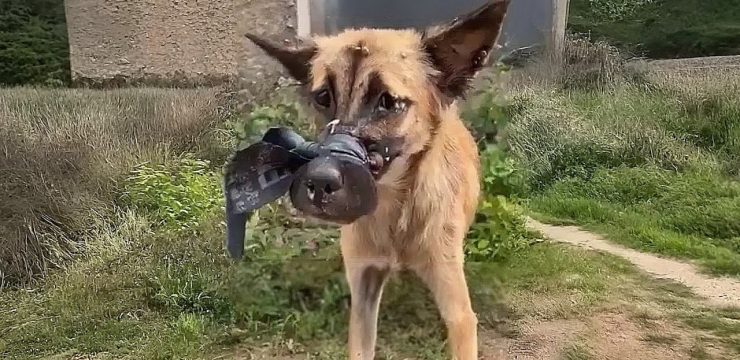
It was during this quiet collapse that the dog appeared.
The first time, Emma thought it was just a coincidence. She noticed him in the reflection of a shop window—a medium-sized dog with slightly dusty fur and an attentive, almost solemn gaze. He followed her at a distance, silent and steady. She quickened her pace, and he did the same. When she reached her building, he stopped and stayed back, watching.
The next day, he was there again.
And the day after that.
He never begged for food. He never barked or approached too closely. He simply followed, like a quiet shadow that refused to leave. Over time, Emma stopped consciously acknowledging him, yet deep inside, his presence stirred something she couldn’t quite explain. It was as if, in a world that felt increasingly cold and indifferent, someone—or something—was quietly keeping watch over her.
But the pressure continued to build.
One morning at the hospital, Emma overheard two nurses discussing the urgency of her mother’s treatment. Their words were hushed, but the message was clear. There was no more time to wait. Something inside her broke. She stepped into the hallway, leaned against the cold white wall, and let the tears fall freely for the first time. She felt small, powerless, overwhelmed by numbers and circumstances she could not control.
That evening, everything changed.
Emma walked down the street in a daze, her mind filled with dark, relentless thoughts. She repeated to herself that she wasn’t going to make it. That despite everything she had done, it wouldn’t be enough to save the woman who had raised her alone, loved her unconditionally, and protected her all her life.
Then suddenly, the dog ran ahead of her.
Before she could react, he grabbed her bag gently but firmly in his mouth.
“Hey! Let go of that!” she shouted, startled.
But he didn’t.
She pulled. He resisted.
It wasn’t aggressive. It wasn’t violent. It was something else entirely—an insistence, a quiet but unshakable determination. His eyes locked onto hers, and in them was something deeply moving. A silent urgency. A plea she could feel but not yet understand.
People around them began to slow down. Heads turned. Some reached for their phones. Others stepped closer, curious but cautious.
Emma, already pushed beyond her limits, felt everything inside her erupt. At first, she shouted. Then her voice cracked. And suddenly, the tears came again, unstoppable.
“I can’t do this anymore…” she whispered, almost to herself.
Someone asked if she was okay. A woman gently placed a hand on her shoulder. And just like that, the words began to pour out of Emma, like a dam finally breaking. She spoke about Margaret, about the hospital bills, about the fear of losing the only family she had left. She spoke about the crushing loneliness, the feeling of standing alone in front of something impossible.
A different kind of silence settled over the crowd.
Heavier. Warmer. Human.
Faces changed.
A man in his fifties asked how much she needed. A college student immediately offered to share her story online. A local shop owner suggested organizing a community fundraiser. Ideas emerged naturally, almost instinctively, as if her vulnerability had unlocked something in everyone around her.
And the dog?
He slowly released her bag.
Then he sat beside her.
Calm. Still.
As if he had been waiting for that exact moment.
In the days that followed, Emma’s story spread far beyond that street corner. Donations began to arrive—some small, some unexpectedly generous. But more than the money, it was the messages that touched her the most. Words of encouragement. Stories from strangers who had faced their own battles. Reminders that she was not alone.
For the first time in weeks, Emma slept through the night without waking up in fear.
Margaret’s treatment began.
The early days were filled with uncertainty. Every phone call from the hospital made Emma’s hands tremble. Every visit was a fragile mix of hope and fear. She would sit by her mother’s bed, holding her hand, speaking softly even when Margaret seemed too weak to respond.
Then one morning, the doctor walked in with a small, reassuring smile.
A smile Emma had almost forgotten how to recognize.
“The treatment is working,” he said gently. “She’s stabilizing. The immediate danger has passed.”
Emma stood still, unable to process the words. And then the tears came again—but this time, they were different. Lighter. Freeing.
The day Margaret was finally discharged, Emma stepped outside the hospital first, her heart racing.
And there he was.
Sitting quietly near the entrance, as if he had never left.
The dog.
He looked up at her.
Emma dropped to her knees on the pavement, uncaring of who might be watching. She wrapped her arms around him, holding him close.
“You started all of this…” she whispered.
She named him Hope.
Because that was exactly what he had been—the spark of hope when everything else had felt lost.
From that day on, Hope was no longer a stray. He became part of their family. Margaret, still recovering but smiling again, would often stroke his head and call him their silent angel.
As for Emma, she never saw strangers the same way again. She had learned that sometimes, all it takes is a single unexpected moment—a glance, a gesture, something unexplainable—to awaken the kindness in others.
And sometimes, that moment comes from the most unlikely place.
Even now, when she walks down that same street with Hope by her side, Emma carries a quiet certainty in her heart:
Even in the darkest moments, there is always a light waiting to be found.