When the “Dogs Are Family” rescue team received word about a stray dog wandering the streets of the Colón area, nothing could have prepared them for what they were about to witness. Years of dedicating their lives to saving animals had given these compassionate volunteers a certain resilience — a hardened but loving heart that allowed them to face suffering without being completely undone. But this dog shattered every boundary they thought they had built.
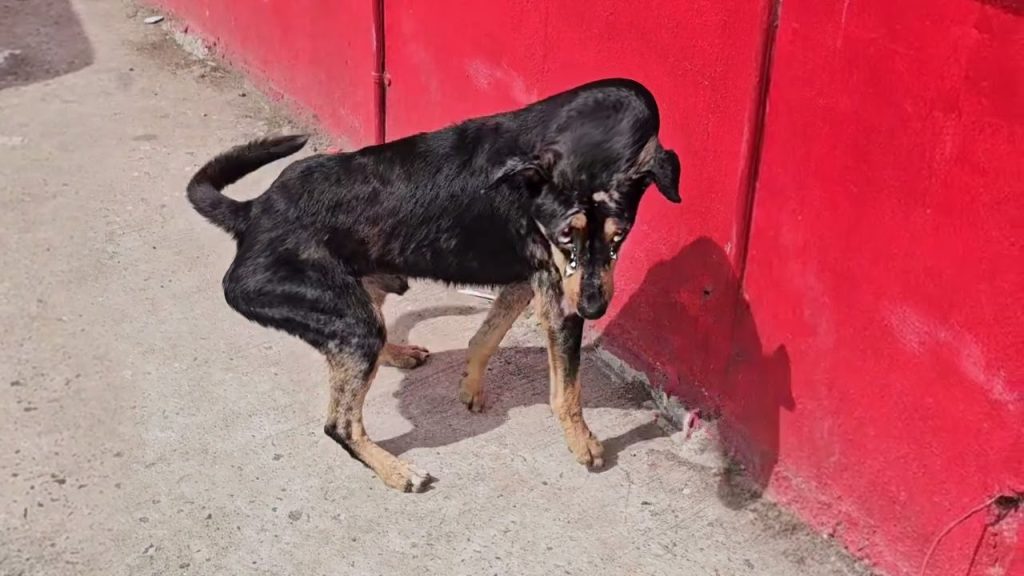
He was alive. That much was certain. But the way he moved — or rather, struggled to move — was something none of them had ever seen in all their combined years of rescue work. His neck bent at a sharp, unnatural angle, twisted as though frozen mid-turn by some invisible, merciless force. His legs, too, were contorted, making each step a painful, labored effort that broke the heart of every person who witnessed it. Walking was a challenge. Eating was nearly impossible. Drinking water — something every living creature does without thinking — had become a daily battle just to survive.
The rescuers stood there, visibly shaken. These were not newcomers to heartbreak. They had seen neglect, abuse, illness, and injury in forms that most people never encounter in a lifetime. Yet standing before this dog, they openly admitted that in all their years of doing this work, they had never come across a case this extreme. That kind of honesty, coming from people who have seen so much, says everything about just how severe this little dog’s condition truly was.
Without hesitation, they scooped him up and rushed him to the Serviver veterinary clinic, where the real work of understanding his condition could begin.
At the clinic, a fuller picture of his situation began to emerge — though many questions remained painfully unanswered. Local residents in the area had shared what information they could, but their accounts were conflicting. Some said he had been living this way for a short while; others suggested the condition had persisted for much longer. The truth of how long this dog had endured such physical hardship on his own, surviving on the streets without help, without a family, without anyone to ease his pain — that truth remained unclear.
What was clear, however, was that the cause of his severe physical condition was completely unknown. His twisted neck and malformed legs were not the result of an obvious injury that could be seen and immediately addressed. The underlying reason for his suffering was a mystery, and that mystery made helping him all the more urgent and all the more complex. The rescue team knew they needed more than general veterinary care. They began actively reaching out to find a veterinary neurologist — a specialist who could examine him more deeply and offer a second opinion that might point them toward answers.
To even begin mapping out a treatment plan, the dog required a full and comprehensive set of medical tests. Complete blood counts, chemistry panels, and snap tests were all necessary to understand what was happening inside his body. Each test carried a cost. Each specialist consultation carried a cost. And for a rescue organization that runs entirely on the generosity of animal lovers, those costs add up fast.
The team turned to their community, reaching out with an earnest and heartfelt plea for financial support. Rescues like this one do not happen without resources, and resources do not appear without people who care enough to give. The call for help was not made lightly — it was made out of sheer necessity, because this dog deserved a fighting chance, and giving him that chance required more than love alone.
Perhaps the most quietly moving moment in the entire rescue was a simple, practical one. The team showed what this dog’s daily life required just to function: a specially elevated feeding station, carefully designed so that he could reach his food given the severe angle of his neck. Such a small thing. Such a profound thing.
Think about what that means. On the streets, there were no elevated bowls. There was no one adjusting his environment to meet his needs. Every meal, every sip of water had been an enormous struggle — and yet, somehow, against all odds, he had survived. Day after day, in pain, alone, and overlooked by a world that moved too fast to notice a small, broken dog doing his best to stay alive.
His story is not just a rescue story. It is a reminder — a powerful, aching reminder — that suffering can exist quietly, just around the corner, in places we do not think to look. It is a reminder that animals cannot speak for themselves, cannot ask for help, cannot explain what they are going through. They simply endure, until someone chooses to stop and see them.
The “Dogs Are Family” team stopped. They saw him. And because they did, this dog — once invisible to the world — finally had a name, a warm place to rest, and a team of people fighting with everything they had to give him the life he always deserved.
He may not know the words. But somewhere in those eyes, worn down by hardship and yet still soft, still trusting — there is something that looks very much like gratitude.